


HSLH, HSLCH and HSLHSH 300/500 V LSZH Control Cable Guide: Bedded vs Non-Bedded Copper Braid, Steel-Wire Braid and YY/CY/SY Selection
Compare HSLH (YY LSZH), HSLCH (CY LSZH bedded vs non-bedded), and HSLHSH (SY LSZH steel-braided) 300/500V control cables against standard PVC YY, CY, and SY.

- Rated Voltage & Equivalents
- 300/500 V | HSLH (YY) · HSLCH (CY) · HSLHSH (SY)
- HSLCH Screen Options
- Non-Bedded (Compact PET) vs. Bedded (EMC)
- EMC vs. Mechanical Braid
- Tinned Cu Braid (HSLCH) vs. Steel (HSLHSH)
- Zero-Halogen Compliance
- IEC 60332-3-24 · 60754 Acid · 61034 Smoke
EMC vs. Impact Defense
HSLCH Copper Screen vs. HSLHSH Steel Braid
Tinned copper braid blocks inverter/encoder EMI; galvanized steel wire braid adds mechanical crush defense (not an EMC screen).
Bedding & Enclosed Fire
Non-Bedded Compact vs. LSZH Inner Bed
Choose PET-wrapped non-bedded HSLCH for tight conduits or extruded LSZH inner bedding for full 360° gland compression.
Selecting LSZH control cables requires matching three parameters: fire-safety compound (LSZH vs PVC), braid function (unscreened HSLH, copper-screened HSLCH, or steel-braided HSLHSH), and inner bedding (PET vs LSZH). In cleanrooms, data centers, and public buildings, standard PVC YY, CY, and SY cables release dense black smoke and corrosive HCl acid gas during fires. Upgrading to the TEBAOFLEX Industrial Power & Control Cable LSZH trio (HSLH, HSLCH, and HSLHSH) satisfies IEC 60332-3-24, IEC 60754, and IEC 61034 fire-safety mandates while preserving EMC compatibility.
How Do HSLH, HSLCH and HSLHSH Map to Standard PVC YY, CY and SY Control Cables?
In European and British control engineering, HSLH, HSLCH, and HSLHSH serve as the 300/500 V low-smoke zero-halogen (LSZH) counterparts to PVC YY, CY, and SY cables.
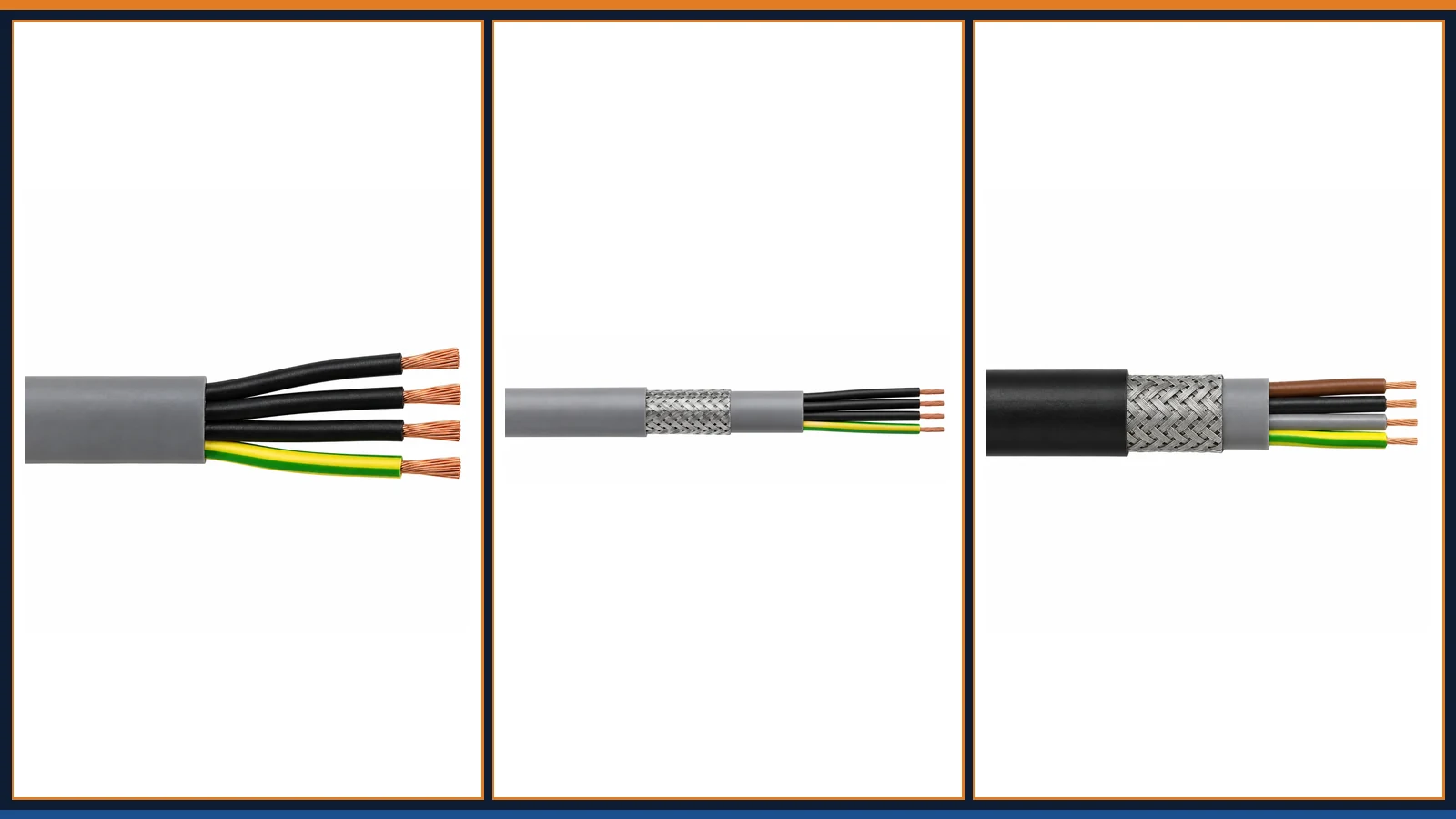
- HSLH (YY LSZH — Unscreened Flexible Control). HSLH (YY LSZH) Flexible Control Cable uses Class 5 plain copper conductors, black LSZH cores with white numerals, and a grey LSZH outer layer. Three-core and larger -JZ builds include a green/yellow protective earth core. It replaces standard PVC YSLY-JZ / YSLY-OZ Control Cable in halogen-free buildings and machine cells.
- HSLCH (CY LSZH — Tinned-Copper-Screened Control). HSLCH (CY LSZH) 300/500 V Screened Control Cable adds an overall tinned-copper wire braid screen inside a grey LSZH outer layer. Available in both non-bedded (PET tape separator) and bedded (LSZH inner layer) builds, it replaces standard PVC CY Control Cable and YSLYCY-JZ Screened Control Cable on EMC-sensitive automation circuits.
- HSLHSH (SY LSZH — Galvanized-Steel-Wire-Braided Control). HSLHSH (SY LSZH) Control Cable pairs flexible copper cores and TI6 LSZH insulation with TM7 LSZH bedding and galvanized steel wire braid (≥50% coverage). A black TM7 LSZH outer layer encloses the steel braid. It replaces PVC SY Control Cable where production lines need mechanical abrasion protection without halogen emissions.
For a complete breakdown of -JZ, -OZ, -JB, and -OB core identification codes across PVC control families, see our companion YY, SY, CY and YSLY Control Cable Selection Guide.
How Do All Seven TEBAOFLEX LSZH and PVC Control Cable Series Compare?
Comparing the three LSZH control series (HSLH, HSLCH, HSLHSH) against their four PVC counterparts lets engineers standardize conductor sizes (0.5 mm² to 35 mm²) across standard and zero-halogen plants.
Table 1. Engineering Matrix: TEBAOFLEX LSZH (HSLH / HSLCH / HSLHSH) vs PVC (YY / CY / SY / YSLY) Control Cables
| Cable Model & Product Link | Voltage Rating | Compound System | Inner Layer Under Braid | Braid / Screen Material | Core Identification | Primary Installation Environment |
|---|---|---|---|---|---|---|
| HSLH (YY LSZH) Flexible Control Cable | 300/500 V (2000 V test) | VDE 0207-303-7 LSZH core & grey LSZH outer | None (unscreened assembly) | None (unscreened) | Black cores with white numerals + G/Y (3G+) | Indoor halogen-free control cabinets, cleanrooms, and public buildings |
| HSLCH (CY LSZH) Screened Control Cable | 300/500 V (2000 V test) | VDE 0207-303-7 LSZH core & grey LSZH outer | Choice: PET tape (non-bedded) or LSZH inner bedding | Overall tinned-copper wire braid (EMC screen) | Black cores with white numerals + G/Y (3G+) | EMC-sensitive PLC analog/digital I/O and inverter control in LSZH zones |
| HSLHSH (SY LSZH) Steel-Braided Control | 300/500 V (2000 V test) | TI6 LSZH core, TM7 LSZH bedding & black TM7 LSZH outer | Extruded TM7 LSZH inner bedding | Galvanized steel wire braid (≥50% coverage) | Color-coded (4G: brown, black, grey, G/Y) or numbered | Conveyors, assembly lines, and machine tools requiring mechanical armor + LSZH |
| YSLY-JZ / YSLY-OZ (YY) PVC Control | 300/500 V | Flexible PVC core & grey PVC outer | None (unscreened assembly) | None (unscreened) | Numbered (-JZ / -OZ) or color-coded (-JB / -OB) | General indoor industrial machinery and OEM control panels |
| CY Tinned-Copper-Braided PVC Control | 300/500 V | PVC core & grey or transparent PVC outer | PET separator tape or PVC bedding | Tinned-copper wire braid (EMC screen) | Black cores with white numerals + G/Y | Industrial EMC signal and control wiring in standard PVC plants |
| YSLYCY-JZ Screened PVC Control Cable | 300/500 V | PVC core, inner PVC bedding & transparent/grey PVC outer | Extruded PVC inner bedding | Tinned-copper wire braid (≥80% optical coverage) | Black cores with white numerals + G/Y | High-noise VFD cabinets, servo feedback, and European OEM machinery |
| SY Galvanized Steel-Braided PVC Control | 300/500 V | PVC core, PVC bedding & transparent PVC outer | Extruded PVC inner bedding | Galvanized steel wire braid | Black cores with white numerals + G/Y | Machine tool drops exposed to swarf, foot traffic, and light impact |
Sources: DIN VDE 0285 / EN 50525-3-11, BS EN 50525-2-51, IEC 60228 Class 5, and EN 50363-7 / 50363-8 LSZH compounds.

When Should Engineers Choose Bedded vs Non-Bedded HSLCH (CY LSZH) Constructions?
When ordering HSLCH Screened Control Cable, engineers must specify whether the layer under the copper braid is a PET tape (non-bedded) or LSZH bedding (bedded).
Table 2. Construction Comparison: Non-Bedded (PET Tape) vs Bedded (LSZH Inner Sheath) HSLCH (CY LSZH)
| Design Parameter | Non-Bedded HSLCH (PET Separator Build) | Bedded HSLCH (LSZH Inner Bedding Build) |
|---|---|---|
| Layer Under Tinned-Copper Braid | Helically wrapped polyester (PET) separator film | Extruded circular LSZH inner bedding compound |
| Finished Outer Diameter (OD) | Smaller (8%–15% slimmer for the same core count and size) | Larger (due to the radial thickness of the extruded inner bedding) |
| Bending Flexibility & Weight | Lighter and more supple in tight panel wireways (6 × OD fixed) | Firmer circular cross-section (6 × OD fixed, 15 × OD flexing) |
| Double-Seal EMC Gland Fit | Single outer compression seal + braid clamping cone | Supports inner-bedding seal + 360° braid clamp + outer seal |
| Stripping Protection for Cores | Requires careful braid trimming so snips do not nick core insulation | Extruded LSZH bedding shields insulated cores during braid stripping |
| Best Engineering Use Case | High-density PLC marshalling ducts and compact OEM machine frames | Heavy industrial enclosures, high-vibration glands, and wet/dusty entries |
Sources: EN 62444 360° EMC compression gland sealing practice and TEBAOFLEX HSLCH bedded vs non-bedded datasheets.
Why Panel Builders Must Check Bedded vs Non-Bedded Before Ordering EMC Glands
Even at the exact same core schedule (such as 4G1.5 mm² or 12G0.75 mm²), a bedded HSLCH cable has a larger outer diameter than a non-bedded HSLCH cable. Confirming the bedded or non-bedded build before sizing metric M16, M20, or M25 EMC brass glands ensures a gas-tight seal and 360° shield contact.
How Does HSLCH Tinned-Copper Screening Differ from HSLHSH Galvanized-Steel Braiding?
Although both HSLCH (CY LSZH) and HSLHSH (SY LSZH) use a woven metallic wire braid under the outer LSZH layer, tinned copper and galvanized steel serve different roles.
- HSLCH (CY LSZH) — Low-Impedance Tinned-Copper EMC Screen.
- Material & Coverage. Woven from fine tinned-copper wires with high optical coverage over either a PET separator or LSZH bedding.
- Primary Function. Provides a low-transfer-impedance electrostatic and high-frequency electromagnetic shield (kHz to MHz range). It blocks fast dV/dt switching noise from variable-frequency drives (VFDs), servo drives, and heaters from coupling into 24 V DC PLC inputs or 0–10 V analog commands.
- Mechanical Limitation. Soft annealed tinned-copper wire has low tensile yield strength and must never support hanging cable weight or crushing loads.
- HSLHSH (SY LSZH) — High-Strength Galvanized-Steel Mechanical Braid.
- Material & Coverage. Woven from galvanized steel wires (≥50% minimum stated coverage) over an extruded TM7 LSZH inner bedding and enclosed in a black TM7 LSZH outer layer.
- Primary Function. Protects the TI6 LSZH insulated cores against abrasion, metal machining swarf, pinching, and light impact along assembly lines, bottling conveyors, and automated handling cells.
- Electrical Limitation. Because steel has high magnetic permeability and 7–8× higher electrical resistivity than copper, a galvanized steel braid exhibits high skin-effect impedance at kilohertz frequencies. It is a mechanical protection layer, not a substitute for HSLCH tinned-copper EMC screening, and it cannot serve as a circuit protective earth (PE) conductor.
For a deeper comparison between SY steel-wire braid and heavy SWA single-wire armor on fixed feeders, see our YY vs YSLYSY Control Cable Comparison.

Why Do IEC 60332-3-24, IEC 60754 and IEC 61034 Mandate LSZH Over PVC in Enclosed Spaces?
When control cables are bundled inside rail tunnels, airport terminals, hospitals, data centers, or cleanrooms, fire hazards shift to bunched vertical flame spread, smoke obscuration, and acid-gas corrosion.
Table 3. Fire-Safety Test Suite on TEBAOFLEX HSLH, HSLCH and HSLHSH LSZH Control Cables
| Standard Reference | Test Category | Engineering Requirement & Field Impact |
|---|---|---|
| VDE 0207-303-7 / TI6 & TM7 | Halogen-free thermoplastic/elastomeric compound | Formulated with metal hydroxide flame retardants (ATH / MDH) containing zero PVC, chlorine, bromine, or fluorine |
| IEC/EN 60332-1-2 | Single vertical wire flame propagation | Self-extinguishes when a single vertical cable sample is exposed to a 1 kW pre-mixed burner flame |
| IEC/EN 60332-3-24 (Cat C) | Bunched vertical ladder flame spread | Prevents vertical fire runway when multiple control cables are tightly bundled on vertical risers and tray ladders |
| IEC/EN 60754-1 & 60754-2 | Halogen acid gas emission, pH & conductivity | Evolved gas contains <0.5% halogen acid, with aqueous pH > 4.3 and conductivity <10 µS/mm to protect PCB electronics |
| IEC/EN 61034-1 & 61034-2 | Smoke density (3 m cube photometric test) | Maintains ≥60% minimum light transmittance so evacuation corridors and emergency exit signage remain visible |
Sources: IEC 60332-1-2, IEC 60332-3-24 (Category C bunched flame), IEC 60754-1 / 60754-2 (zero halogen / acid gas), and IEC 61034-2.
Protecting High-Value PLC and Server Electronics from Secondary Acid Corrosion
Even a small electrical fire involving standard PVC YY, CY, or SY cables releases gaseous HCl. That gas mixes with humidity and sprinkler mist to deposit hydrochloric acid across every nearby PLC backplane, VFD IGBT module, and server rack. Specifying HSLH (YY LSZH), HSLCH (CY LSZH), and HSLHSH (SY LSZH) eliminates acid-gas corrosion (IEC 60754-1/-2), preventing secondary equipment loss after minor panel faults.
How Should Panel Builders Terminate HSLH, HSLCH and HSLHSH Cables at Control Enclosures?
Proper stripping, gland clamping, and earthing ensure that HSLH, HSLCH, and HSLHSH cables maintain their -30 °C to +70 °C fixed temperature rating and 2000 V dielectric strength.
- Respect Fixed vs Occasional Flexing Bend Radii.
- For HSLH (YY LSZH): Maintain a minimum bending radius of 4 × OD for fixed installation and 12.5 × OD for occasional flexing.
- For HSLCH (CY LSZH) and HSLHSH (SY LSZH): Maintain 6 × OD for fixed installation and 15 × OD (HSLCH) or 20 × OD (HSLHSH) for occasional flexing. None of the three cables should be used in high-acceleration continuous drag chains without consulting TEBAOFLEX for a dedicated PUR/TPE drag-chain build.
- Use 360° EMC Glands or Shield Clamps on HSLCH (CY LSZH). Strip 15–20 mm of the outer grey LSZH layer at the cabinet entry so the brass EMC gland or DIN-rail clamp makes 360° contact with the copper braid. Avoid twisting the braid into a long “pigtail” drain wire, which adds series inductance and degrades high-frequency MHz shielding by more than 20 dB.
- Terminate HSLHSH (SY LSZH) Steel Wire Braid in Mechanical Braid Glands. Cut galvanized steel wires are springy and sharp, so terminate HSLHSH in a dedicated SY braid-clamping gland bonded to chassis earth (PE). Alternatively, fold the steel braid back under a heat-shrink boot inside the gland cone so stray steel filaments never reach live terminal blocks.
- Always Use the Internal Green/Yellow (G/Y) Core for Protective Earth. On 3-core and larger -JZ schedules (such as 3G1.5 or 4G2.5), land the green/yellow copper core directly on the enclosure PE terminal using a crimped ferrule.

Frequently Asked Questions
What do the cable codes HSLH, HSLCH and HSLHSH stand for?
In European and UK low-smoke zero-halogen (LSZH) control cable nomenclature, HSLH is the unscreened LSZH counterpart to YY (YSLY-JZ/OZ). HSLCH adds a tinned-copper wire braid screen (C) as the LSZH counterpart to CY (YSLYCY-JZ). HSLHSH adds an inner LSZH bedding and a galvanized steel wire braid (SH) beneath the outer LSZH layer as the counterpart to SY (YSLYSY).
What is the difference between bedded and non-bedded HSLCH (CY LSZH) cable?
Non-bedded HSLCH places a thin polyester (PET) separator tape directly over the cabled cores beneath the tinned-copper braid, yielding a smaller outer diameter and lighter weight for tight panel ducts. Bedded HSLCH extrudes a circular LSZH inner layer beneath the tinned-copper braid, providing extra core protection during stripping and a firmer round profile for double-seal EMC cable glands.
Can the galvanized steel wire braid on HSLHSH (SY LSZH) be used as an EMC screen or earth conductor?
No. Galvanized steel wire has high magnetic permeability and much higher electrical resistance than tinned copper. It therefore provides poor high-frequency electromagnetic shielding and cannot carry fault current as a protective earth (PE) conductor. Always use the internal green/yellow copper core for PE bonding, and specify HSLCH (CY LSZH) whenever tinned-copper EMC screening is required.
What voltage and test voltage ratings apply to HSLH, HSLCH and HSLHSH?
All three TEBAOFLEX LSZH control cable series (HSLH, HSLCH, and HSLHSH) are rated at 300/500 V operating voltage (Uo/U) with a 2000 V AC dielectric test voltage. They use Class 5 flexible copper conductors per IEC 60228 and operate from −30 °C to +70 °C in fixed installations and −5 °C to +70 °C during occasional flexing.
How are the cores identified in HSLH, HSLCH and HSLHSH control cables?
In TEBAOFLEX HSLH and HSLCH reference schedules, the cores use black LSZH insulation printed with white sequential numerals. Three-core and larger builds include a green/yellow protective earth core (-JZ / G schedule). In the documented 4-core HSLHSH (SY LSZH) schedule, the cores are color-coded brown, black, grey, and green/yellow, with numbered multicore schedules also available.
Which flame, smoke and halogen standards do HSLH and HSLCH meet?
TEBAOFLEX HSLH and HSLCH reference constructions cite VDE 0207-303-7 for LSZH compound properties, IEC/EN 60332-1-2 for single vertical flame propagation, and IEC/EN 60332-3-24 for bunched vertical flame spread. They also reference IEC/EN 60754-1 and -2 for zero halogen acid gas emission and IEC/EN 61034-2 for low smoke density.
Engineering RFQ & Datasheet Review
Specify HSLH, Bedded/Non-Bedded HSLCH, or Steel-Braided HSLHSH Core Count
Share your core × mm² schedule (e.g. 2–61 cores, 0.5–35 mm²), OZ vs JZ green/yellow earth core, EMC copper braid vs GSWB steel braid, and CPR reaction-to-fire class.


