


IEEE 323 Class 1E Nuclear & 232°C Geothermal ESP Cable Guide
Select IEEE 323 Class 1E LOCA power and instrumentation cables, 200 MRad X-ETFE fuel-pool camera umbilicals, and 232°C Monel-armored geothermal ESP cables.


- Class 1E Qualification
- 600 V – 15 kV | 60-Year LOCA Duty
- Radiation Ceiling
- X-ETFE Type T13–T37 (200 MRad Pool)
- Downhole ESP
- ESP 450 MLE / DW 450 FL to +232 °C
- Dielectric / Armor
- FR-EPR / CSPE | Extruded Pb + Monel 400
Nuclear Class 1E
60-Yr LOCA Containment & 200 MRad Pool
SPEC 175–340-60 FR-EPR/CSPE passes radiation-LOCA envelopes; Type T13–T37 inspects 50 m fuel pools.
232 °C Geothermal ESP
ESP 300 Round vs. Lead-Sheathed 450 MLE
Sour H₂S brine above +150 °C requires extruded lead barrier + Monel 400 armor to prevent gas decompression.
Nuclear containment safety circuits and 232 °C geothermal downhole pumps push organic polymers past conventional industrial limits. Standard PVC or XLPE jackets harden under cumulative gamma radiation, fail Loss-of-Coolant Accident (LOCA) borated steam exposure, or blister under 35 MPa sour geothermal gas decompression. Explore our industrial power and control hub and verify conductor resistance using the voltage drop calculator.
1. How Do Nuclear Class 1E and 232°C Geothermal ESP Families Compare Across Standards?
No single insulation system solves both ionizing nuclear containment doses and supercritical geothermal gas decompression. Nuclear engineers prioritize thermoset FR-EPR/CSPE or X-ETFE cross-linked chains resistant to gamma embrittlement. Downhole geothermal engineers rely on fluorinated polymers backed by extruded lead sheaths and high-nickel alloy armoring.
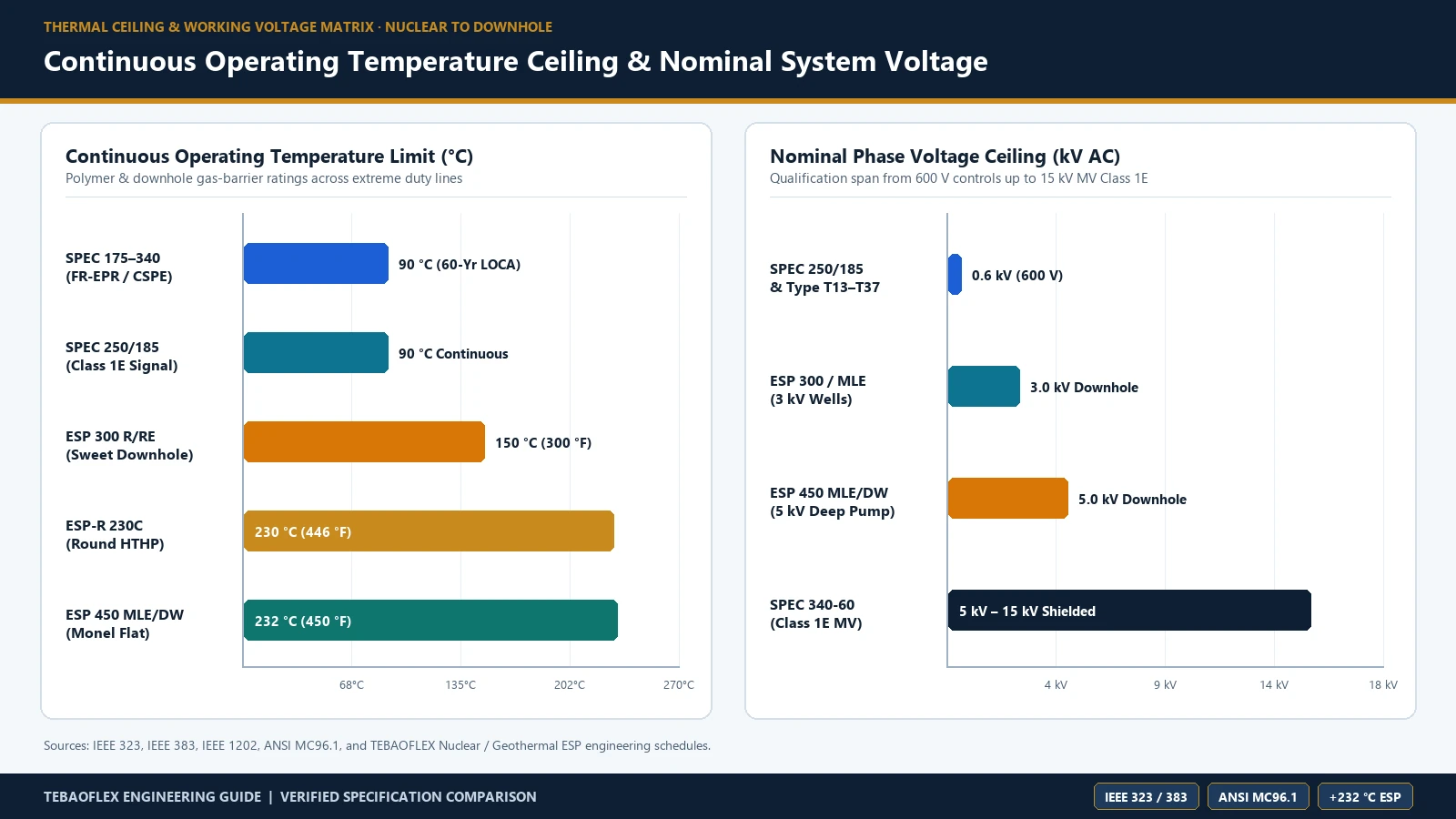
Table 1 contrasts governing qualification profiles, nominal voltage classes, primary dielectric barriers, and typical field environments across all four product series.
| Cable Family | Governing Profile | Voltage Class | Primary Dielectric & Jacket | Shield / Strength Barrier | Typical Industrial Service |
|---|---|---|---|---|---|
| SPEC 175 / 275 / 325 / 340 Class 1E Power | IEEE 323, IEEE 383, ICEA S-95-658 |
600 V, 5 kV, 15 kV |
FR-EPR (90 °C) + CSPE (Hypalon) |
Unshielded or copper tape (5–15 kV) |
60-year Class 1E motors, MOVs & LOCA ducts |
| SPEC 250-60 & SPEC 185-60 Class 1E Instrument/TC | IEEE 323, IEEE 383, ANSI MC96.1 |
600 V Class 1E |
FR-EPR + CSPE over pair/triad/TC |
Al-Mylar (IS+OS) + 18 AWG drain |
Reactor sump PAM, RTDs & Type KX/EX probes |
| Type T13–T37 & X-ETFE Pool Camera | 200 MRad Gamma (ETFE Cross-linked) |
600 V (300/600 V hybrid) |
Dual X-ETFE / radiation-grade PUR |
Kevlar (3.5–9.5 kN) + 75 Ω coax |
50 m borated spent-fuel pools & RPV cameras |
| ESP 300, DW 450 FL & ESP 450 MLE | IEEE 1018 / IEEE 1019 profiles |
3 kV, 4 kV, 5 kV |
EPDM / Polyimide + Extruded Lead |
0.51–0.76 mm Monel 400, 316L or Galv |
150–232 °C (35 MPa) geothermal & SAGD pumps |
Sources: IEEE 323, IEEE 383, IEEE 1202, ANSI MC96.1, API/IEEE 1018 guidelines, and TEBAOFLEX engineering datasheets.
For dry-panel fluoropolymer hookup wire rated 200 °C to 450 °C outside nuclear containment, see our fluoropolymer, mica, and HV DC wire guide. Browse wet-duty power feeders in the submersible pump cable catalog.

2. How Do Class 1E LOCA Power, Control, and Thermocouple Cables Handle 60-Year Submersion?
Specify SPEC 175/275/325/340-60 Class 1E cables for 600 V and 5–15 kV safety pump feeders. Pair them with SPEC 250-60 shielded pairs and SPEC 185-60 thermocouple loops for reactor post-accident monitoring (PAM).
During a design-basis LOCA, containment feeders absorb high thermal aging followed by ionizing gamma radiation and alkaline borated spray. Thermoset flame-retardant ethylene-propylene rubber (FR-EPR) maintains dielectric strength throughout saturated steam submersion at elevated containment pressures. Over that core wall, a heavy chlorosulfonated polyethylene (CSPE) jacket blocks chemical attack, surface abrasion, and flame propagation under IEEE 1202 vertical tray tests.
Low-level analog transmitters and thermocouple loops require strict electromagnetic immunity alongside LOCA endurance:
- Single-Core & Multi-Core Class 1E Power:
SPEC 175-60covers18 AWG–1000 kcmilsingle cores (6.1 mmat12 AWG).SPEC 325-60adds grounded3C/4Cmotor leads (15.7–36.1 mm). - Shielded
SPEC 250-60Telemetry:1–24twisted pairs orRTDtriads use individual and overallAl-Mylarfoil with18 AWGtinned drain wires (8.6–27.2 mm). - Calibrated
SPEC 185-60Thermocouple Extension:1–8pairs use solid or7-strandChromel (+)andConstantan (-)(Type EXpurple/red) orType KXalloys matched to plant EMF curves.
| Series | Reference Code | Conductor / Core Construction | Primary Protection / Armor | Nominal OD or Profile | Approx. Mass (kg/km) |
|---|---|---|---|---|---|
SPEC 175-60 |
SPEC 175-60-2/0 |
1C × 2/0 AWG (67.4 mm²) Tinned Cu |
2.03 mm FR-EPR + 1.14 mm CSPE |
16.8 mm (0.66") |
790 |
SPEC 250-60 |
SPEC 250-60-04P16 |
4 Pairs × 16 AWG (7×24) Tinned Cu |
IS+OS Al-Mylar + 1.52 mm CSPE |
16.3 mm (0.64") |
345 |
Type T18 PTZ |
Type T18 (50 m pool) |
1×75 Ω Coax + 6×0.50 + 11×0.25 mm² |
4.5 kN Kevlar + X-ETFE System |
13.4 mm (98 kg/km wet) |
245 (Air) |
ESP 450 MLE |
ESP 450 MLE-5KV-4AWG |
3 × 4 AWG (21.2 mm²) Solid Cu |
Polyimide + EPDM + Lead + Monel 400 |
12.7 × 34.5 mm Flat |
2,050 |
Sources: TEBAOFLEX production specifications and IEEE 323 / API downhole dimensional tables.
3. When Are 200 MRad X-ETFE Pool Cables and 232°C Lead-Sheathed ESP Cables Mandatory?
Select Type T13–T37 X-ETFE pool cables whenever refueling bridge cameras winches flex continuously near spent fuel racks. Step up to ESP 450 MLE and DW 450 FL cables for 232 °C sour geothermal brine wells up to 35 MPa.
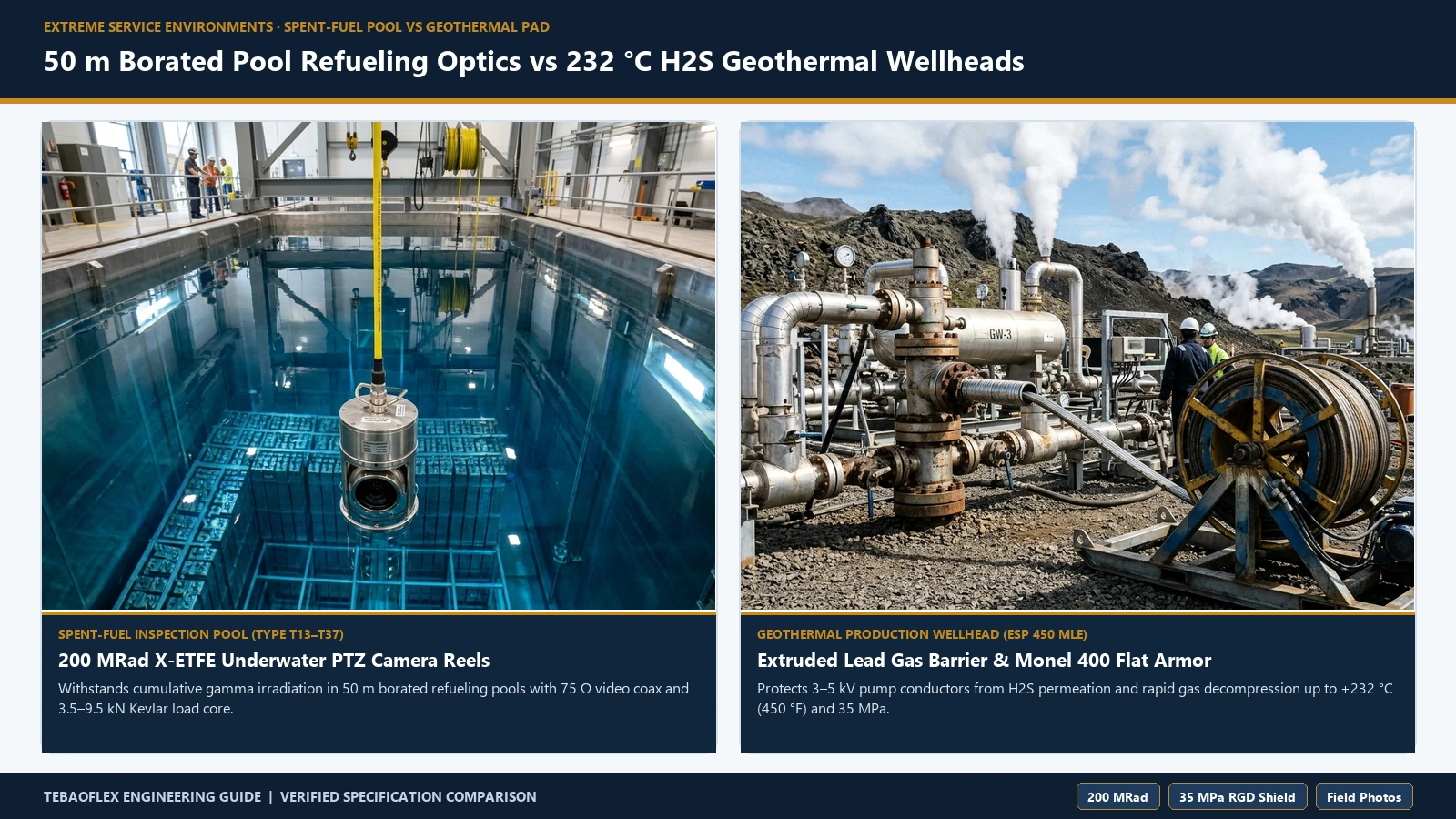
In spent-fuel pools (up to 50 m depth), standard fluoropolymers like PTFE embrittle rapidly under moderate gamma fields. Radiation-crosslinked ETFE (X-ETFE) resists up to 200 MRad total cumulative dose. At the same time, Type T13 (11.8 mm, 3.5 kN Kevlar) through Type T37 (18.8 mm, 9.5 kN Kevlar) stay flexible on portable reels. Integrated double-shielded 75 Ω coax preserves crisp underwater inspection video next to refueling manipulator drives.
Downhole geothermal and steam-assisted gravity drainage (SAGD) wells destroy elastomeric jackets through rapid gas decompression (RGD) and hydrogen sulfide attack:
150 °CModerate Wells (ESP 300 R / RE): Round3–5 kVEPDMconstructions (28.4–33.8 mm) handle sweet brine artificial lift using galvanized or stainless armor.232 °CExtreme Sour Wells (ESP 450 MLE/DW 450 FL): Extruded lead sheaths hermetically block supercriticalH2S,CO2, and methane permeation across polyimide/EPDMcores (10.9 × 29.2 mmto17.5 × 47.2 mm).- Sulfate-Free High-Chloride Protection (
Monel 400): Interlocked0.51 mmMonel 400flat strip prevents stress-corrosion cracking where standard316Lor galvanized steel fails.
Check all armored downhole sizes inside our oil and gas cable hub and confirm instrumentation pair continuity across our instrumentation catalog.
4. Which Misapplications Trigger Insulation Embrittlement or Downhole Gas Decompression?
Never run plain copper sensor wire on thermocouple loops, never deploy unarmored elastomeric ESP cables above 150 °C sour brine, and never leave PTFE cables near active reactor fuel assemblies.
Even minor material shortcuts cause catastrophic plant shutdowns. Connecting copper SPEC 250-60 leads onto Type KX or Type EX thermocouples introduces parasitic cold-junction voltages across terminal blocks. Those millivolt offsets corrupt reactor safety interlocks. Likewise, pulling downhole flat ESP cables through tight tubing clearances without solid copper conductors weakens gas resistance. Without an extruded lead barrier, pressurized well gases diffuse into insulation voids and rupture the wall during shutdown.
Selection boundary: Do not substitute non-qualified commercial EPR or PTFE wires into IEEE 323 Class 1E safety circuits or spent-fuel racks above their cumulative gamma dose rating. On 232 °C sour geothermal ESP wells, always verify wellhead packoff sealing dimensions and Monel 400 armor compatibility against downhole chloride and H2S brine chemistry.
5. What Engineering Data Should Accompany Nuclear or Geothermal RFQ Inquiries?
Specify target qualification code (IEEE 323/383 or downhole 232 °C), voltage class (600 V–15 kV), exact Alloy Type (KX/EX) or AWG size, and maximum outer profile (mm). Include wellhead tubing clearance, cumulative radiation dose (MRad), and factory acceptance test sheets from our certificates and compliance page.
NUCLEAR & HTHP GEOTHERMAL RFQ
Submit Wellbore Profile, Class 1E Spec & Test Protocol
Share your circuit duty (SPEC 175/275/325/340, SPEC 250/185, Type T13–T37, or ESP 450 MLE), voltage rating, AWG conductor size, and brine or radiation limits. TEBAOFLEX engineers confirm wall thickness, Monel 400 or lead-sheath options, and continuous drum lengths cleanly.
6. Frequently Asked Questions
Why does SPEC 185-60 use Chromel and Constantan conductors instead of tinned copper?
Thermocouple extension circuits require matched Seebeck alloy coefficients all the way to the reference panel. Using standard copper conductors would distort Type EX or Type KX millivolt signals.
Why choose X-ETFE over PTFE inside nuclear spent-fuel pools?
Standard PTFE degrades mechanically under relatively low gamma irradiation thresholds. Electron-beam crosslinked ETFE (X-ETFE) endures up to 200 MRad cumulative dose while preserving flex life on underwater reels.
When does a geothermal ESP well require Monel 400 armor instead of galvanized steel?
Galvanized steel armoring corrodes rapidly in hot chloride brines and sour H2S steam phases. Monel 400 nickel-copper strip resists acid attack and sulfide stress cracking up to 232 °C.
Why is an extruded lead sheath used under geothermal ESP armor?
Elastomers alone remain permeable to pressurized wellbore gases at 35 MPa. A continuous extruded lead barrier forms a metallic seal around insulated cores to prevent explosive decompression blistering.


