


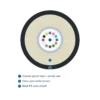
Wind Farm Outdoor Fiber Optic Cable
Outdoor wind farm communications, turbine-to-network optical routes and primary or secondary cable ducts, with appropriate indoor transition arrangements. Fiber count: 2–24 Singlemode options: 9/125, G.652D or G.655 Multimode options: 50/125 or 62.5/125 Reinforcement / sheath: Glass yarn / black PE Operating temperature: -25 to +70 °C
- Fiber count2–24
- Singlemode options9/125, G.652D or G.655
- Multimode options50/125 or 62.5/125
- Reinforcement / sheathGlass yarn / black PE
- Operating temperature-25 to +70 °C
- Transport and storage temperature-25 to +70 °C
- Installation temperature-5 to +50 °C
- Conductor / voltage ratingOptical, all-dielectric construction; not a power cable
Wind Farm Outdoor Fiber Optic Cable Core Identification & Ratings
- Type: Industrial Cables
- Fiber count: 2–24
- Singlemode options: 9/125, G.652D or G.655
- Multimode options: 50/125 or 62.5/125
Electrical, Thermal & Mechanical Bend Limits
- Reinforcement / sheath: Glass yarn / black PE
- Operating temperature: -25 to +70 °C
- Transport and storage temperature: -25 to +70 °C
- Installation temperature: -5 to +50 °C
- Conductor / voltage rating: Optical, all-dielectric construction; not a power cable
Wind Farm Outdoor Fiber Optic Cable Conductor, Insulation & Sheath Build
The following layer specification identifies the representative construction and the separately selectable variants.
- Layer / feature: Construction
- Optical elements: 2–24 fibers, selected singlemode or multimode type
- Central tube: Loose tube filled with thixotropic gel
- Cable sealing: Dry sealing system
- Reinforcement: Dielectric glass yarn
- Outer sheath: Black polyethylene (PE
Match the complete layer build
Select G.652D or G.655 singlemode, or the specified 50/125 or 62.5/125 multimode fiber. These alternatives are not interchangeable optical specifications. Glass yarn provides dielectric reinforcement and basic rodent protection; it is not metal armor or a promise of rodent-proof performance.
Order the inspection scope with the cable
State the applicable standard, cable configuration, dimensional requirements and required electrical, mechanical or optical inspections in the purchase specification. Where motion is involved, include the angle, effective length, speed, temperature, repeated cycles and loading so that the acceptance conditions remain comparable.
Primary Electrical & Mechanical Performance
- Match the complete layer build: Select G.652D or G.655 singlemode, or the specified 50/125 or 62.5/125 multimode fiber.
- Order the inspection scope with the cable: State the applicable standard, cable configuration, dimensional requirements and required electrical, mechanical or optical inspections in the purchase specification.
- Review the installation as a system: Provide the duct geometry and pulling method before selecting the strength option.
- Select pulling strength separately from optical capacity: Each listed strength option can contain 2–24 fibers.
Industrial Oil, Flame & Environmental Protection
- Route / use: Selection check
- Duct route: Match the pulling plan to the strength option.
- Optical connection: Coordinate fiber and transceiver interfaces.
- Building entry: Specify the fire and transition requirement.
IEC / EN / VDE / UL Reference Standards
- Reference / performance: Application
- DIN VDE 0888-3: Outdoor optical cable construction reference.
- ITU-T G.652D / G.655: Selected singlemode fiber alternatives.
- 50/125 or 62.5/125: Selected multimode fiber geometry; specify the optical performance class separately.
- All-dielectric construction: Glass-yarn reinforcement; no metallic cable layer.
Industrial Cable Selection & Routing Guides
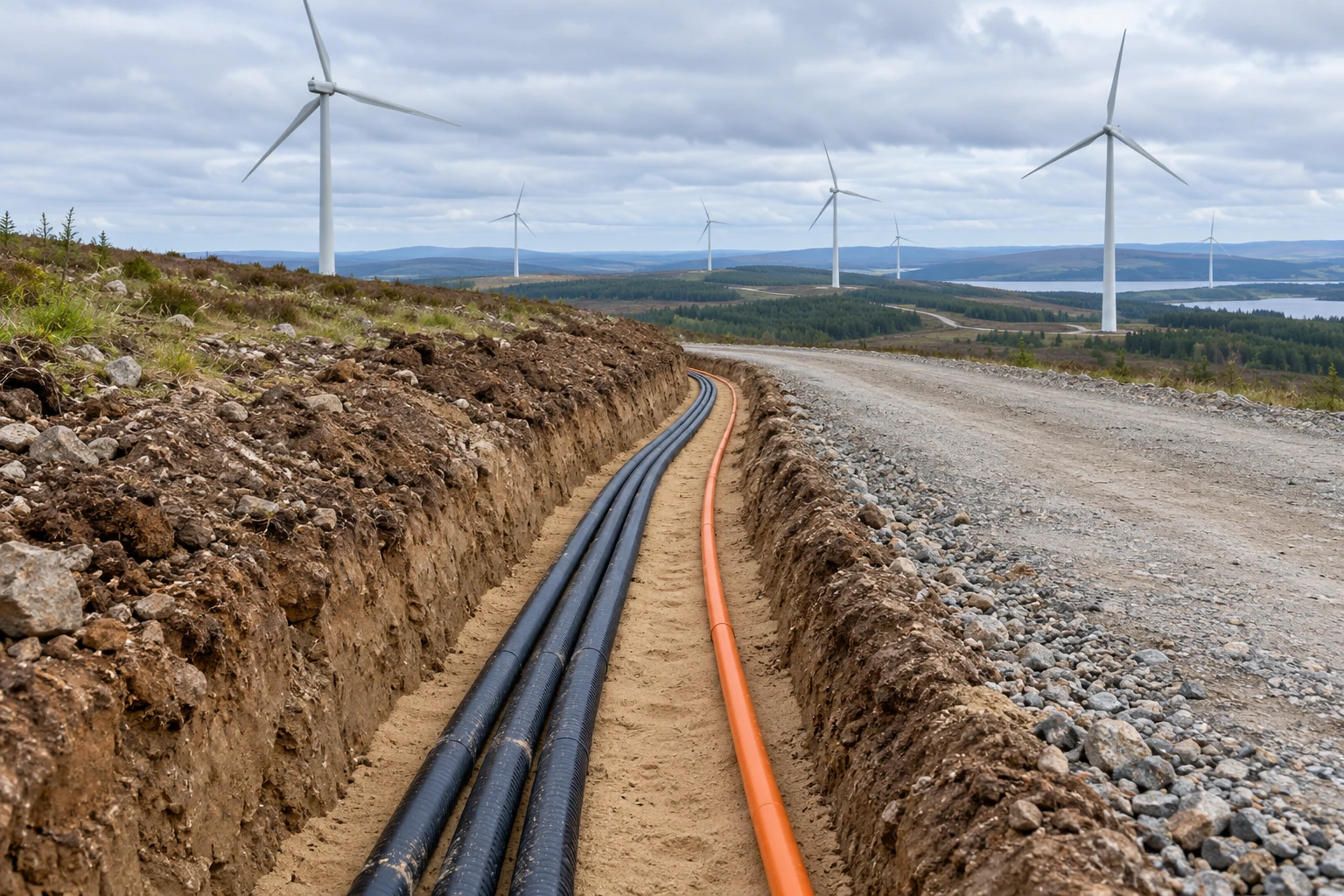
Wind Farm Outdoor Fiber Optic Cable Industrial Installation & Routing Guide
Wind farm outdoor fiber optic cable carries optical data between turbines, field equipment and the communications network. The A-DQ(ZN)B2Y-type construction combines fibers in a central gel-filled loose tube, dry cable sealing, glass-yarn dielectric reinforcement and a black PE sheath. The all-dielectric design contains no metallic armor, electrical conductor or metallic screen.
Select the fiber type, count and reinforcement option together with the route. Duct installation, joint enclosures and equipment interfaces require a complete optical and mechanical specification. A dielectric fiber route avoids a continuous metallic cable path, while the network link still needs the right optical budget and compatible transceivers.
Typical Plant, Machine & Infrastructure Circuits
- Outdoor wind farm communications, turbine-to-network optical routes and primary or secondary cable ducts, with appropriate indoor transition arrangements.
- Route / use: Selection check
- Duct route: Match the pulling plan to the strength option.
- Optical connection: Coordinate fiber and transceiver interfaces.
- Building entry: Specify the fire and transition requirement.
Review the installation as a system
Provide the duct geometry and pulling method before selecting the strength option. Coordinate cable support, sealing, fiber management and bend control at the joint enclosure. Verify the optical budget and end-to-end acceptance tests after installation. Choose a separate torsion-rated fiber or hybrid cable for a continuously moving turbine interface.
Compare related cable duties
- Wind Farm MV Collector Cable, Copper & Aluminum XLPE/PE
- 0.6/1 kV PVC Wind Turbine Torsion Power & Control Cable
- 1000 V WTTC Shielded VFD Motor Cable
Wind Farm Outdoor Fiber Optic Cable Specification & Selection FAQ
Why is 'Match the complete layer build' critical when specifying Wind Farm Outdoor Fiber Optic Cable?
Select G.652D or G.655 singlemode, or the specified 50/125 or 62.5/125 multimode fiber. These alternatives are not interchangeable optical specifications. Glass yarn provides dielectric reinforcement and basic rodent protection; it is not metal armor or a promise of rodent-proof performance.
How should engineers address 'order the inspection scope with the cable' for Wind Farm Outdoor Fiber Optic Cable?
State the applicable standard, cable configuration, dimensional requirements and required electrical, mechanical or optical inspections in the purchase specification. Where motion is involved, include the angle, effective length, speed, temperature, repeated cycles and loading so that the acceptance conditions remain comparable.
What is the engineering rule regarding 'review the installation as a system' on Wind Farm Outdoor Fiber Optic Cable?
Provide the duct geometry and pulling method before selecting the strength option. Coordinate cable support, sealing, fiber management and bend control at the joint enclosure. Verify the optical budget and end-to-end acceptance tests after installation. Choose a separate torsion-rated fiber or hybrid cable for a continuously moving turbine interface.
What core insulation, bedding, and shielding architecture is built into Wind Farm Outdoor Fiber Optic Cable?
Layer / feature: Construction; Optical elements: 2–24 fibers, selected singlemode or multimode type; Central tube: Loose tube filled with thixotropic gel; Cable sealing: Dry sealing system; Reinforcement: Dielectric glass yarn
Use the values for the stated construction and duty. D means finished cable outside diameter; a bend-radius multiplier refers to radius, not loop diameter.
TEBAOFLEX® — Wind Farm Outdoor Fiber Optic Cable technical parameters
| Parameter | Value / condition |
|---|---|
| Fiber count | 2–24 |
| Singlemode options | 9/125, G.652D or G.655 |
| Multimode options | 50/125 or 62.5/125 |
| Reinforcement / sheath | Glass yarn / black PE |
| Operating temperature | -25 to +70 °C |
| Transport and storage temperature | -25 to +70 °C |
| Installation temperature | -5 to +50 °C |
| Conductor / voltage rating | Optical, all-dielectric construction; not a power cable |
| Bend requirement | Confirm installation and service radii for the selected strength option |
TEBAOFLEX® — Wind Farm Outdoor Fiber Optic Cable configuration comparison
| Nominal OD (mm) | Weight (kg/km) | Max. installation pulling force (N) | Max. static force (N) |
|---|---|---|---|
| 7.3 | 50 | 1000 | 500 |
| 7.8 | 55 | 1500 | 800 |
| 8.3 | 65 | 2000 | 1000 |
| 8.5 | 70 | 2500 | 1250 |
| 8.9 | 75 | 3000 | 1500 |
Select pulling strength separately from optical capacity
Each listed strength option can contain 2–24 fibers. Moving from the 7.3 mm to the 8.9 mm option increases the stated maximum installation pulling force from 1,000 to 3,000 N; it does not increase the permitted wind-yaw cycles. Dynamic installation pulling force and repeated torsional movement describe different duties.
Coordinate the optical acceptance plan with the fiber type, operating wavelength, link loss budget, connectors, splices and installed route. Mechanical pulling capacity is a separate selection from optical transmission performance.
Selection guide: Send the route drawing, electrical requirements and required quantity with your inquiry. Our engineers can coordinate the selected construction, finished diameter, connection details and delivery lengths with your equipment and installation specification.
Ordering & Quotation Checklist: Send fiber count and exact type, optical interfaces and link budget, route length, strength option, duct and bend layout, joint enclosures, indoor transitions, delivery lengths and quantity.


Request Quotation & Datasheet for This Cable
Need factory pricing, cross-section drawing or a full PDF datasheet for Wind Farm Outdoor Fiber Optic Cable? Share your core count, conductor size, length and destination country—our Taicang cable engineers reply within 24 hours.
- ISO 9001 Factory Direct
- MOQ 50 m (Custom Builds)
- 24h Engineering Reply
You may also like…


Related products
-

PROFIBUS Power Hybrid Drag Chain Cable
-

TC-ER Tray Control Cable, Shielded and Unshielded
-

(N)TMCHXOEU, (N)TSCGEHXOEU & (N)TMCGC11Y MV Wind & Switchgear Cable (6–69 kV)
-

PROFIBUS DP & PA Fieldbus Cable: 150 Ω Type A & 100 Ω Process Bus Cable
-
Single Pair Ethernet Cable for Industrial Networks
-

MIL-DTL-17 RG178, RG179, RG316 & RG188 PTFE/FEP Coaxial Cable
-

Cat7 S/FTP Industrial Ethernet Cable
-

Fire-Resistant RS-485 Bus Cable