


S1BN8-F, S1BC4N8-F, S07BB-F, S1BB-F and TML Type B Deep-Well & Potable-Water Immersion Cable Selection Guide
Specify deep-well submersible pump, VFD borehole riser, and hygiene-certified potable-water immersion cables across EPR/EPDM, EMC-screened S1BC4N8-F, and TML Type B builds.

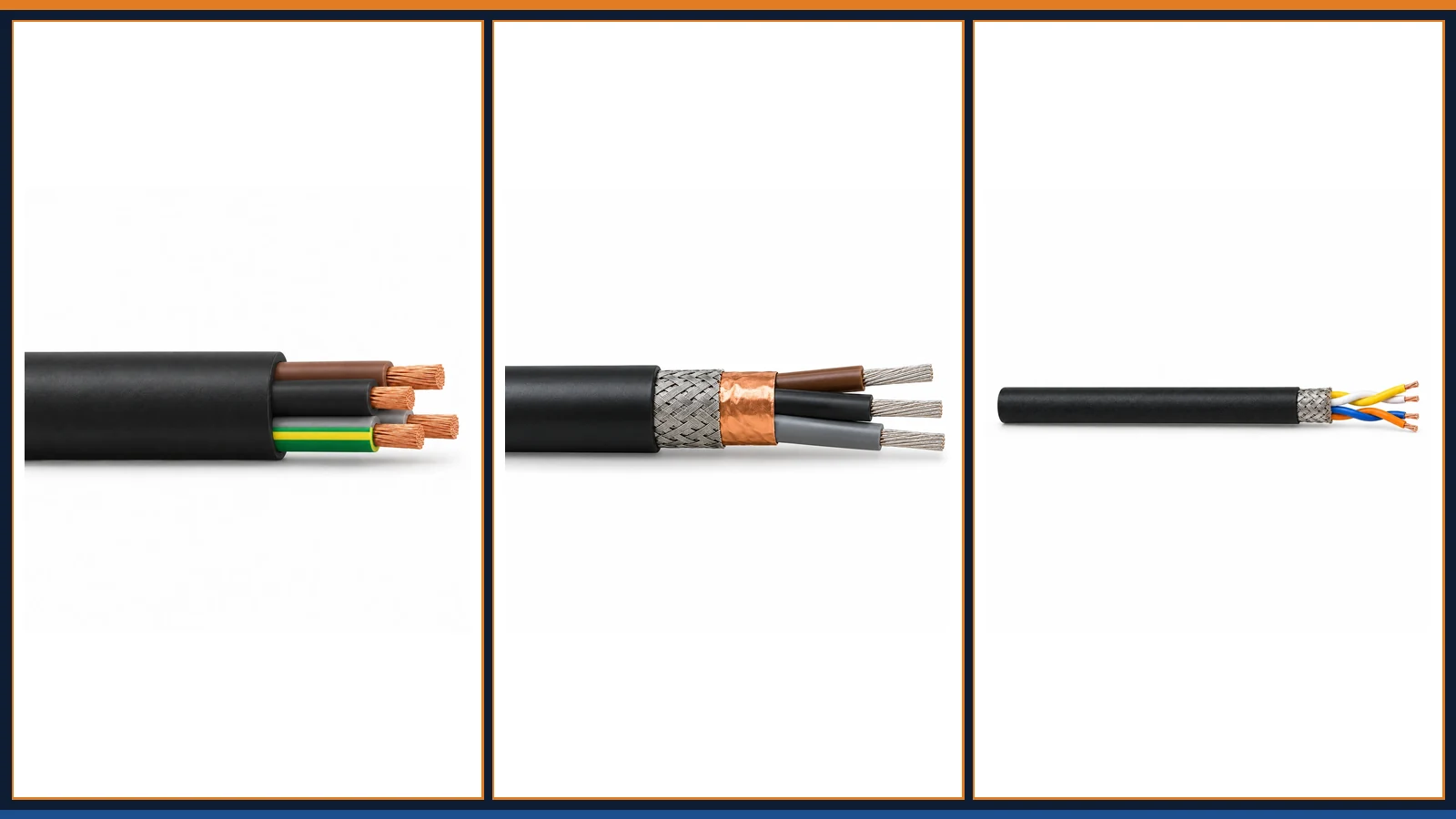
- Immersion Envelope
- 500 m Depth (50 bar) | AD8 | +80 °C Water
- Wastewater & Mine Dewater
- S1BN8-F & Braided S1BC4N8-F (5GM8 NBR)
- Potable Drinking Water
- S07BB-F / S1BB-F / TML Type B EPDM
- VFD & Quarry Duty
- Versolex HD Unscreened & C4 Screened VSD
Non-Potable vs. Drinking Well
5GM8 NBR S1BN8-F vs. Certified EPDM S1BB-F
Brackish mine water needs nitrile NBR oil/chemical defense (S1BN8-F); potable municipal wells strictly mandate KTW/WRAS/ACS EPDM.
Tight Casing & Inverter
Parallel Flat TML Type B vs. C4 Braid VSD
Slip flat Type B profiles cleanly beside deep riser pipes and specify ≥80% C4 tinned-copper braid on VFD submersible pumps.
Continuous deep-water immersion places extreme hydrostatic pressure, osmotic water-absorption stress, and variable-speed inverter (VSD) transient spikes on electrical feeders. Standard polychloroprene (PCP) cords such as H07RN-F 450/750 V flexible rubber power cables are engineered for shallow or intermittent AD8 immersion down to 10 m in untreated industrial water. However, chlorinated elastomers leach plasticizers, sulfur accelerators, and halogens that violate European and international drinking-water hygiene regulations. Furthermore, high hydrostatic pressure beyond 100 m forces water molecules into conventional compounds.
Related Engineering & Product Scope
To engineer reliable deep-well riser drops, municipal water-treatment intakes, and mine-dewatering shafts, electrical specifiers rely on four specialized industrial elastomer feeder families and wet-environment energy systems. The industrial group includes S1BN8-F & S1BC4N8-F 0.6/1 kV unscreened and EMC-screened immersion cables and Versolex HD 1 kV VSD dewatering cables. The drinking-water group includes S07BB-F, S1BB-F & S1BC4B-F food-grade potable-water cables and TML Flat Type B & Round Type B potable-water riser cables. This engineering guide compares compound chemistry, hydrostatic depth limits, drinking-water certifications (KTW-BWGL, WRAS, ACS, DM 174), and VSD copper-braid screening across all four product series.
1. Hydrostatic Immersion Physics and Potable-Water Hygiene Standards
Selecting an immersion feeder requires balancing two distinct engineering axes. First is chemical hygiene for water intended for human consumption, and second is hydrostatic and mechanical severity across deep risers and VSD drives.
1.1 Potable-Water Approvals (KTW-BWGL, WRAS, ACS, and DM 174)
Standard industrial elastomers use sulfur-donor curing agents, aromatic process oils, and chlorinated polymers that impart odor, taste, Total Organic Carbon (TOC) migration, and microbial nutrients into standing water. Cables installed in municipal water wells, potable reservoirs, mineral-water aquifers, or food and beverage wash water must pass four European statutory approvals.
- KTW-BWGL & DVGW W270 (Germany). KTW-BWGL evaluates cold-water (23 °C) organic migration and chemical leaching, while DVGW W270 tests microbiological biofilm growth on the immersed polymer surface over multi-month exposure cycles.
- WRAS BS 6920 (United Kingdom). Tests organoleptic odor and flavor of water, appearance (color and turbidity), growth of aquatic microorganisms, extraction of substances of concern to public health, and extraction of toxic metals.
- ACS — Attestation de Conformité Sanitaire (France). Validates formulation positive lists and migration limits under French Ministry of Health potable-water contact rules.
- DM 174/2004 (Italy). Regulates materials and objects suitable for fixed public water-supply collection, treatment, and distribution plants.
Both S07BB-F / S1BB-F / S1BC4B-F potable-water cables and TML Flat & Round Type B potable-water cables use peroxide-cured, halogen-free, food-grade EPDM compounds. These compounds fully satisfy KTW-BWGL, DVGW W270, WRAS BS 6920, ACS, and DM 174.
1.2 Hydrostatic Depth Pressure and Low Water Absorption
Every 10 meters of vertical water column adds approximately 1 bar (0.1 MPa) of hydrostatic gauge pressure. At 300 m to 500 m immersion depth (30 to 50 bar), ordinary porous polymers experience osmotic water uptake, dielectric swelling, and accelerated insulation resistance breakdown. Deep-well designs such as S1BN8-F & S1BC4N8-F and TML Type B utilize high-density cross-linked compounds with water absorption below 5 to 10 mg/cm² under gravimetric immersion testing.
2. Master Technical Comparison: S1BN8-F, S07BB-F/S1BB-F, Versolex HD VSD, and TML Type B
The table below provides a side-by-side specification matrix across all four deep-well and potable-water immersion cable families manufactured by TEBAOFLEX.
| Model Designation | Nominal Voltage (U₀/U) | Conductor Stranding | Core Insulation | Screen / EMC Layer | Outer Barrier Compound | Max Depth & Water Temp | Target Immersion Application |
|---|---|---|---|---|---|---|---|
| S1BN8-F (#3393) | 0.6/1 kV (max 1.2 kV AC) | Class 5 flexible bare or tinned Cu | 3GI3 high-grade cross-linked elastomer | Unscreened | 5GM8 special NBR / nitrile-modified elastomer | Up to 500 m (50 bar) · +80 °C water | Deep-well industrial water, municipal wastewater, seawater, and slurry |
| S1BC4N8-F (#3393) | 0.6/1 kV (max 1.2 kV AC) | Class 5 flexible bare or tinned Cu | 3GI3 high-grade cross-linked elastomer | Tinned-copper braid (C4, ≥ 80% coverage) | 5GM8 special NBR / nitrile-modified elastomer | Up to 500 m (50 bar) · +80 °C water | VFD-driven deep-well motors requiring EMC harmonic containment and shaft-bearing protection |
| S07BB-F (#3409) | 450/750 V | Class 5 flexible bare or tinned Cu | Food-grade non-toxic EPDM (B) | Unscreened | Food-grade blue/black EPDM (B) | Up to 250 m–300 m · +75 °C water | Potable drinking-water wells, reservoirs, and food-industry tanks (KTW/WRAS/ACS) |
| S1BB-F & S1BC4B-F (#3409) | 0.6/1 kV (max 1.2 kV AC) | Class 5 flexible bare or tinned Cu | Heavy-wall food-grade EPDM (B) | Unscreened (S1BB-F) or tinned Cu braid (S1BC4B-F) | Food-grade blue/black EPDM (B) | Up to 500 m (50 bar) · +85 °C water | Deep potable-water aquifers and VFD-driven municipal water supply stations |
| Versolex HD & HD VSD (#3497) | 0.6/1 kV (1000 V heavy duty) | Class 5 tinned or bare copper | High-dielectric HEPR / cross-linked elastomer | Unscreened or tinned-copper VSD braid screen | Heavy-duty tear-resistant CPE / NBR elastomer | Up to 300 m · +80 °C water | Quarry dewatering, civil tunneling, construction sumps, and VSD slurry units |
| TML Flat & Round Type B (#3501) | 0.6/1 kV (max 1.2 kV AC) | Class 5 flexible bare or tinned Cu | Special low-absorption EPR/EPDM | Unscreened (3C, 4C, or single-core) | Blue food-grade EPDM (Type B potable approved) | Up to 500 m (50 bar) · +70 °C/+85 °C | Narrow well casings (Flat Type B) and deep municipal drinking-water drop pipes (Round Type B) |
Sources: HD 22 / EN 50525, IEC 60529 AD8 permanent water immersion, UBA KTW-BWGL, UK WRAS BS 6920, French ACS, and NSF/ANSI 61.
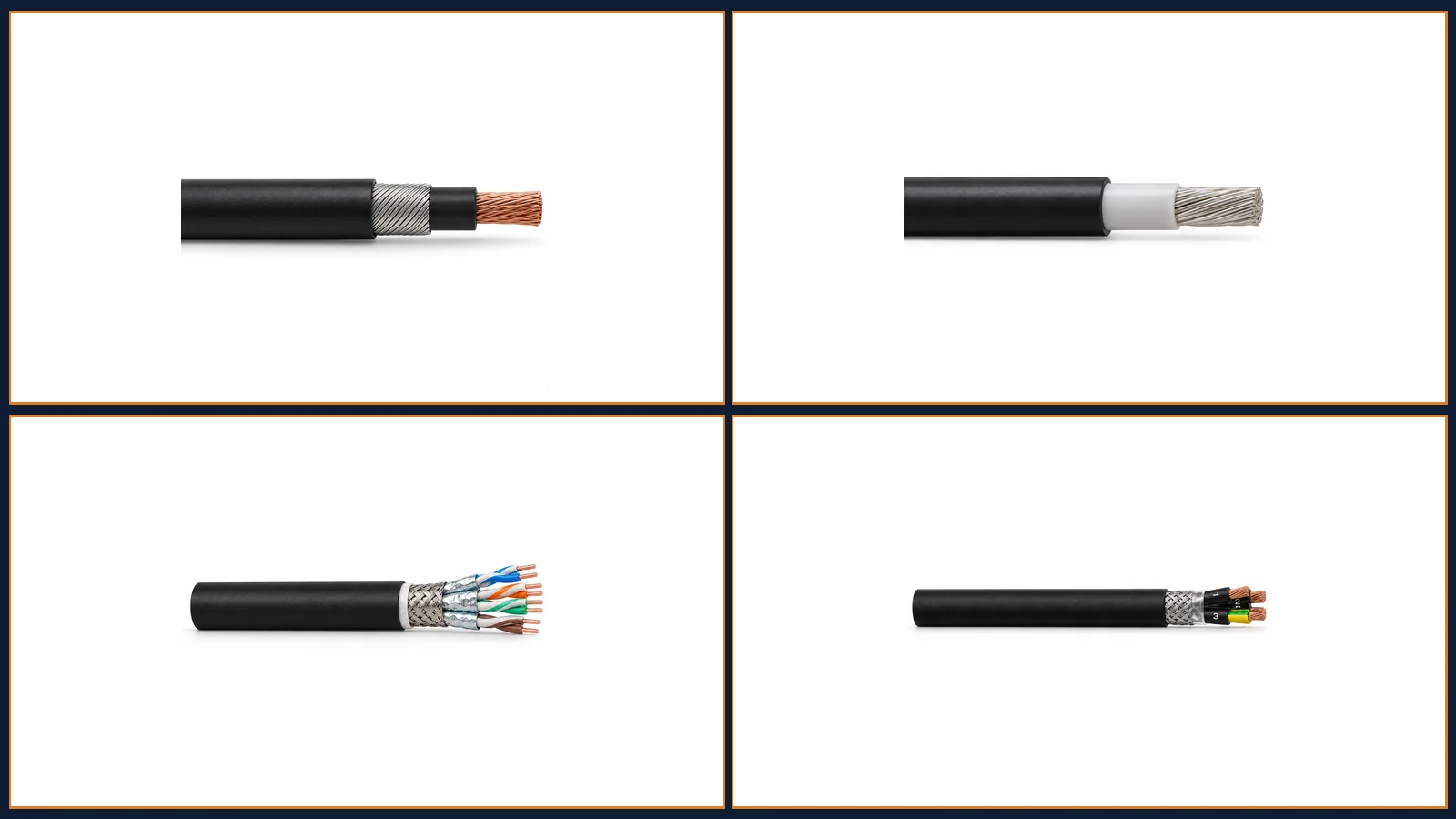
3. Deep-Well Industrial & VFD Immersion: S1BN8-F, S1BC4N8-F, and Versolex HD VSD
When the pumped medium is industrial process water, geothermal brine, municipal sewage, or abrasive quarry slurry, chemical oil resistance and mechanical cut-through strength take priority over drinking-water hygiene.
3.1 S1BN8-F and S1BC4N8-F (0.6/1 kV, Up to 500 m Depth)
Constructed according to HD 22 / EN 50525 structural nomenclature, S1BN8-F and S1BC4N8-F decode into five clear code elements.
- S1. Special heavy-duty design rated U₀/U = 0.6/1 kV (U_m = 1.2 kV).
- B. High-grade ethylene-propylene (3GI3) core insulation rated for continuous 90 °C conductor operation.
- C4 (in S1BC4N8-F). Overall tinned-copper wire braid screen placed over an extruded inner bedding layer to provide low-impedance electromagnetic shielding across 150 kHz to 30 MHz.
- N8. Special nitrile-modified polychloroprene / NBR elastomer compound (5GM8) engineered specifically for permanent AD8 water immersion down to 500 m (50 bar), waste-water sludges, and hydrocarbon-contaminated sumps.
- -F. Class 5 fine-stranded flexible copper conductor per IEC 60228.
Why specify the screened S1BC4N8-F variant? Modern deep-well installations frequently use Variable Frequency Drives (VFDs) to match flow rate to aquifer drawdown. On long vertical drops (100 m to 400 m), PWM inverter dV/dt voltage reflections generate high-frequency capacitive earth currents and shaft-bearing fluting. As detailed in our VFD motor cable selection guide, the C4 tinned-copper braid provides a concentric low-inductance return path to the VFD earth busbar. It also protects adjacent hydrostatic level transmitters from radiated EMI.
3.2 Versolex HD and Versolex HD VSD (1 kV Dewatering & Slurry)
In open-pit quarries, shaft sinking, and civil dewatering sumps, cables are repeatedly dragged over blasted rock, suspended on steel chains, and exposed to emulsified hydraulic oils. Versolex HD and Versolex HD VSD 1 kV cables combine a high-modulus cross-linked insulation wall with a reinforced tear- and oil-resistant outer elastomer barrier. The series is supplied in unscreened (3C, 4C, 7C, 12C power/control) and copper-braid-screened VSD configurations (3C+3E or 4C screened up to 185 mm²). Consequently, Versolex HD VSD eliminates premature insulation failure caused by inverter voltage spikes on long quarry bench risers.
4. Potable-Water Certified Feeders: S07BB-F, S1BB-F, S1BC4B-F, and TML Type B
For municipal water utilities, irrigation aquifers, mineral-water wells, and food-processing reservoirs, any cable contacting the water column must be certified free of halogens, lead, and leachable organic compounds.
4.1 S07BB-F (450/750 V), S1BB-F (0.6/1 kV), and S1BC4B-F (Screened 0.6/1 kV)
S07BB-F, S1BB-F, and S1BC4B-F potable-water cables replace the chlorinated N8 compound with a double-EPDM (BB) food-grade system.
- S07BB-F (450/750 V). Ideal for shallow to medium potable-water wells (up to 250 m), booster stations, and food-grade tank agitators from 1.5 mm² to 35 mm².
- S1BB-F (0.6/1 kV). Heavy-wall 1 kV potable-water feeder supplied in round and flat geometries from 1.5 mm² to 300 mm² for deep aquifers down to 500 m.
- S1BC4B-F (0.6/1 kV EMC Screened). Combines KTW/WRAS/ACS potable-water hygiene with a tinned-copper C4 braid screen for VFD-controlled municipal well fields.
4.2 TML Flat Type B vs Round Type B (0.6/1 kV)
In deep-well drilling, casing diameter directly dictates civil drilling cost. When a 6-inch or 8-inch motor assembly enters a tight well casing, the radial gap between the motor housing and the steel or uPVC casing is often under 15 mm.
TML Flat Type B and Round Type B 0.6/1 kV potable-water cables solve this clearance bottleneck.
- TML Flat Type B (3×1.5 mm² to 3×95 mm² and 4G1.5 mm² to 4G70 mm²). Arranges the cores side-by-side in a parallel flat profile with a signature blue food-grade EPDM outer barrier. A 4G16 mm² flat cable reduces radial height by 35% to 45% compared to a round equivalent, preventing casing scrape during lowering and retrieval.
- TML Round Type B (1×16 mm² to 1×240 mm² and 3C/4C up to 150 mm²). Used along the upper vertical riser pipe where radial clearance is ample and standard round stainless-steel cable cleats or watertight compression glands are installed at the wellhead flange.
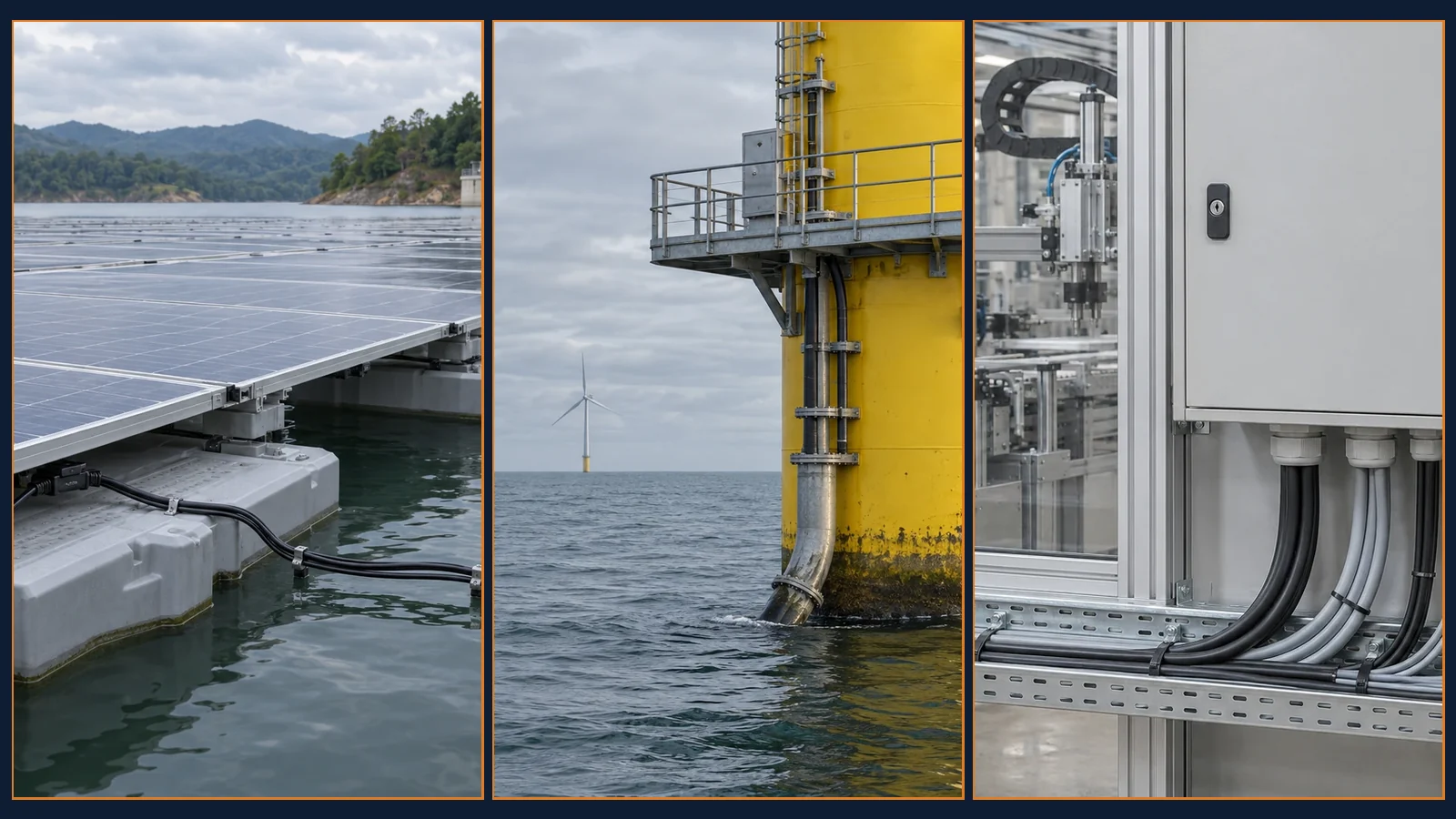
5. Voltage Drop, Star-Delta Dual-Drop Configuration, and Riser Cleating Best Practices
Deep-well motors operate at the end of 100 m to 500 m vertical drops, while wet-rotor motors exhibit high starting inrush currents (5.5 to 7.0 times rated current). Therefore, conductor selection is almost always governed by voltage drop (ΔU ≤ 3%) rather than thermal current capacity alone.
- Direct-On-Line (DOL) vs Star-Delta (Y/Δ) Dual-Cable Drops. For 30 kW to 250 kW Star-Delta motors, running two parallel 3-core cables down the riser pipe splits phase current by 57.7% per cable. Using two smaller TML Flat Type B or S1BB-F cables is significantly easier to clamp and lower than a single massive 4-core cable.
- Riser Pipe Clamping Intervals. Never allow the cable to support its own suspended copper weight over a deep drop. Secure the cable to the vertical riser pipe every 2.5 m to 3.0 m using wide AISI 316 stainless-steel bands lined with EPDM rubber pads. Leave slight thermal slack between flange joints.
- Resin-Cast vs Heat-Shrink Motor Lead Splices. The splice between the factory motor tail and the main riser drop cable sits at the point of maximum hydrostatic pressure. Always use pressure-tested two-part polyurethane resin-cast splice kits or dual-wall adhesive-lined elastomeric sleeves rated for 50 bar immersion. Perform a 1000 V DC Megger insulation resistance check (>200 MΩ) after submerging the splice.
- Surface Floating & Coastal Water Integration. Where deep-well intakes connect to surface reservoirs, pair these immersion cables with 1500 V AD8 floating solar PV cables and outdoor water-blocked industrial Ethernet cables. See our floating solar and renewable array cable guide for reservoir mooring details. For underwater inspection cameras and sonar links, see our companion DLR, CDUR, 2GAX–8GAX, and PCX75 underwater video and coaxial cable guide.
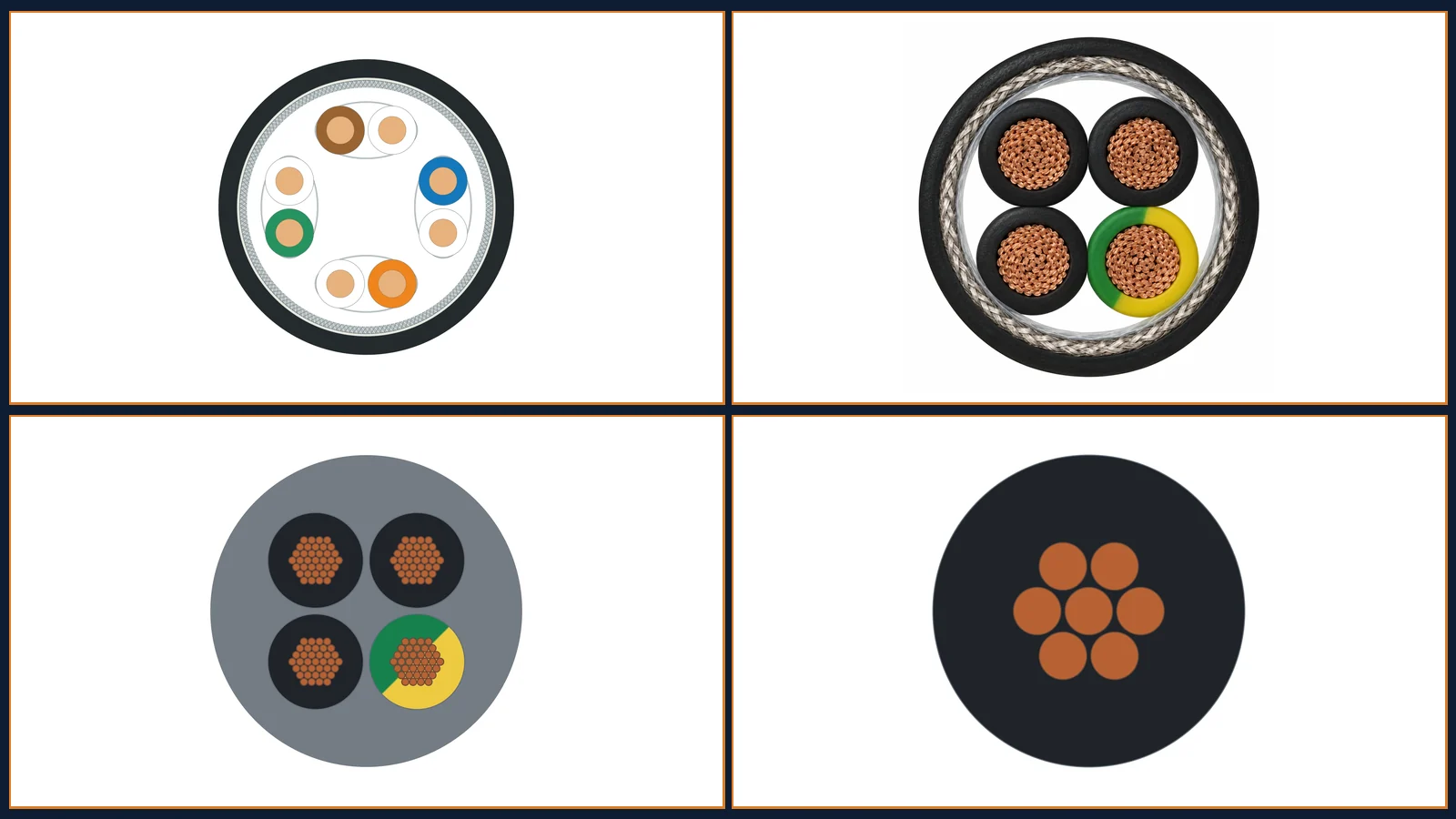
6. Frequently Asked Questions (FAQ)
Can S1BN8-F be used in drinking-water wells?
No. S1BN8-F and S1BC4N8-F use a nitrile-modified polychloroprene (5GM8) compound optimized for industrial water, sewage, seawater, and oil-contaminated sumps. For potable drinking water, always specify S07BB-F / S1BB-F / S1BC4B-F or TML Type B certified to KTW-BWGL, WRAS, ACS, and DM 174.
When should I choose S1BC4N8-F or S1BC4B-F over unscreened immersion cables?
Specify the copper-braid-screened S1BC4N8-F (industrial water), S1BC4B-F (potable water), or Versolex HD VSD whenever the motor is driven by a Variable Frequency Drive on runs exceeding 30 m. Screened designs are also essential where analog 4–20 mA level sensors run in the same shaft.
What is the difference between TML Flat Type B and TML Round Type B?
Both share identical 0.6/1 kV electrical ratings and Type B potable-water EPDM chemistry. TML Flat Type B places cores in a parallel flat geometry to pass through tight radial clearances along the motor body. Conversely, TML Round Type B uses a circular laid-up core geometry suited for larger well casings and circular wellhead stuffing glands.
How does S07BB-F differ from S1BB-F?
S07BB-F is rated 450/750 V for shallow to medium drinking-water wells up to 250–300 m depth. S1BB-F features a thicker 0.6/1 kV insulation and outer barrier rated for deep potable-water aquifers down to 500 m (50 bar) and +85 °C water.
7. Key Takeaways & Engineering Consultation
Summarize your hydrostatic depth, potable-water hygiene standard (KTW-BWGL, WRAS, ACS, or NSF/ANSI 61), and VFD screening requirement before requesting a factory quotation.
- Match compound chemistry to water quality. Use 5GM8 NBR/elastomer (S1BN8-F / S1BC4N8-F and Versolex HD VSD) for wastewater, slurry, and mine dewatering. Specify food-grade Type B EPDM (S07BB-F / S1BB-F / S1BC4B-F and TML Type B) for KTW/WRAS/ACS drinking-water wells.
- Protect VFD-driven deep-well motors. Specify S1BC4N8-F, S1BC4B-F, or Versolex HD VSD with ≥ 80% tinned-copper braid screening (C4) to contain inverter common-mode currents.
- Check radial well-casing clearance and 3% voltage drop. Use flat geometry along narrow motor shrouds and calculate voltage drop across the full vertical riser depth before finalizing conductor cross-section.
Need factory technical datasheets, voltage-drop calculations, or custom cut-to-length drum quotations for your deep-well or municipal water project? Request a custom quotation from TEBAOFLEX Engineering with your motor power (kW), starting method (DOL, Star-Delta, or VFD), setting depth (m), and potable-water certification requirements.
For Italian CEI UNEL FG7R, FG16OH2R16, RG16H1R12, RG7H1M1, and 105 °C RG26H1M16 cables, Spanish UNE RZ1-K (AS/AS+), ROZ1-K, RVFV-K, and RHZ1-OL/HEPRZ1 feeders, and French NF C FR-N1X1G1-flex and FR-N20XA8E-AR utility cables, explore our FG7R, RG16H1R12, RZ1-K (AS), RVFV-K, and RHZ1-OL European CEI, UNE, and NF C feeder guide.
Engineering RFQ & Datasheet Review
Confirm Hydrostatic Immersion Depth, Hygiene Certificate, and VFD Screen
Specify immersion depth (bar / meters), potable-water approval (KTW-BWGL, WRAS, ACS, or TML Type B) vs industrial wastewater (S1BN8-F), flat vs round riser, and core × mm².


