THHN Wire Explained: THHN vs THWN-2 vs XHHW-2, and Where MC, SER, URD and MTW Fit
What THHN wire is, what each letter means, and how it differs from THWN-2, XHHW-2, MC, SER, URD and MTW: ratings, UL standards and where each one belongs.

THHN wire is a single-conductor, 600-volt building wire with PVC insulation under a thin nylon jacket, listed to UL 83 and rated 90 °C in dry locations (Southwire spec 10000). It is commonly sold dual-marked THHN/THWN-2, as both Southwire’s and Cerrowire’s standard THHN products are, which adds a 90 °C rating in wet locations, so the same wire can be pulled through indoor conduit and through underground conduit, which NEC 300.5(B) treats as a wet location (EC&M on NEC 300.5).
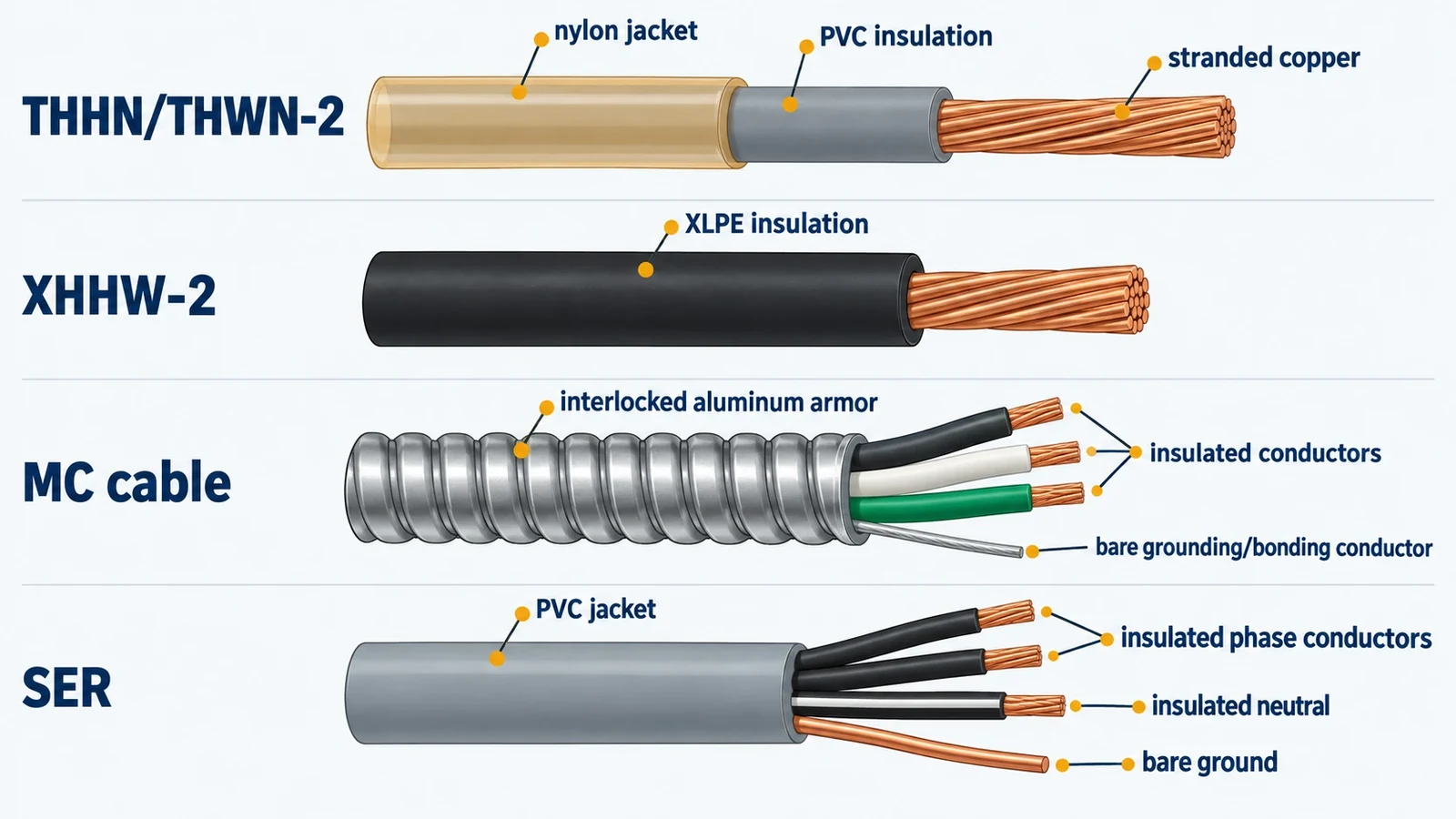
Building wire is the unglamorous part of an electrical project: it goes into the conduit once and nobody thinks about it again, until an inspector reads the print on the jacket. This guide decodes that print, compares the types a buyer meets most often, and marks the boundary where building wire ends and flexible cord begins.
| Type | Construction | Rating (manufacturer data) | Standard / NEC article | Choose it when |
|---|---|---|---|---|
| THHN | Single conductor; PVC insulation, nylon jacket | 600 V; 90 °C dry | UL 83; NEC Article 310 | The run is in a raceway and stays dry |
| THHN/THWN-2 | The same wire, dual-marked | 600 V; 90 °C wet or dry; 75 °C where exposed to oil | UL 83 | Any conduit run that may be wet, including underground conduit |
| XHHW-2 | Single conductor; XLPE insulation, no nylon jacket | 600 V; 1,000 V where the wire is rated and marked 1,000 V; 90 °C wet or dry | UL 44 | Cold sites, low-leakage circuits, or 600–1,000 V circuits using wire marked 1,000 V |
| MC cable | Example (Southwire MC-AP): THHN/THWN conductors and a bare aluminum grounding/bonding conductor inside interlocked aluminum armor | 600 V; conductors 90 °C dry | UL 1569; NEC Article 330 | Exposed or concealed branch circuits where the armor replaces a separate raceway |
| SER | Insulated phase conductors, insulated neutral, bare ground, PVC jacket | 600 V; 90 °C wet or dry | UL 854; NEC Article 338 | Service entrance and above-ground feeders |
| URD triplex / quadruplex | XLPE-insulated 1350-H19 aluminum conductors cabled together | 600 V; 90 °C wet and dry | ICEA S-105-692; USE-2 to UL 854 | Utility secondary distribution in duct or direct burial |
| Overhead triplex service drop | Two XLPE-insulated aluminum conductors around a bare neutral messenger | 600 V; 90 °C (XLPE) | ICEA S-76-474 | Pole-to-building service drops |
| MTW | PVC-insulated machine-tool wire, often multi-rated with THHN/THWN-2 | 600 V; 90 °C dry, 60 °C wet or oil-exposed; stranded only (Southwire) | UL 1063; NFPA 79 | Wiring inside machine enclosures and control panels |
| NM-B | Insulated conductors in a non-metallic sheath | 90 °C conductors; ampacity limited to the 60 °C column | UL 719; NEC Article 334 | Normally dry locations in dwellings and other buildings NEC 334.10 permits |
| SO / SOOW (not building wire) | Finely stranded conductors; EPDM insulation and CPE jacket in the 12 AWG example | 600 V; SOOW −40 to +90 °C (example datasheet) | UL 62; NEC Article 400 | Portable equipment and the other uses NEC 400.10 permits |
Sources: Southwire SIMpull THHN/THWN-2 spec 10000, Cerrowire THHN/THWN-2 sheet (rev. 12/2023), Encore Wire XHHW-2 sheet, Service Wire THHN vs XHHW-2, Southwire MC-AP, SER and Romex SIMpull NM-B specs, Priority Wire URD, service-drop and SOOW 12 AWG specs, Alan Wire MTW spec, UL Solutions Wire and Cable Application Guide, RamCorp and EC&M code summaries; NM-B ampacity per NEC 334.80 as summarised by ExpertCE (2023 NEC). All retrieved September 2026; each is linked in the section that uses it.
Safety note. This guide explains product types and jacket markings. It is not installation advice: conductor size, ampacity, overcurrent protection and the permitted wiring method are set by the NEC edition your jurisdiction adopts and by the authority having jurisdiction. Have a licensed electrician design and install the circuit.
What does THHN stand for?
THHN stands for Thermoplastic, High Heat-resistant, Nylon-coated. Each letter in a US building wire designation describes one property of the insulation system, and reading them in order tells you where the wire may be used before you open the spec sheet.
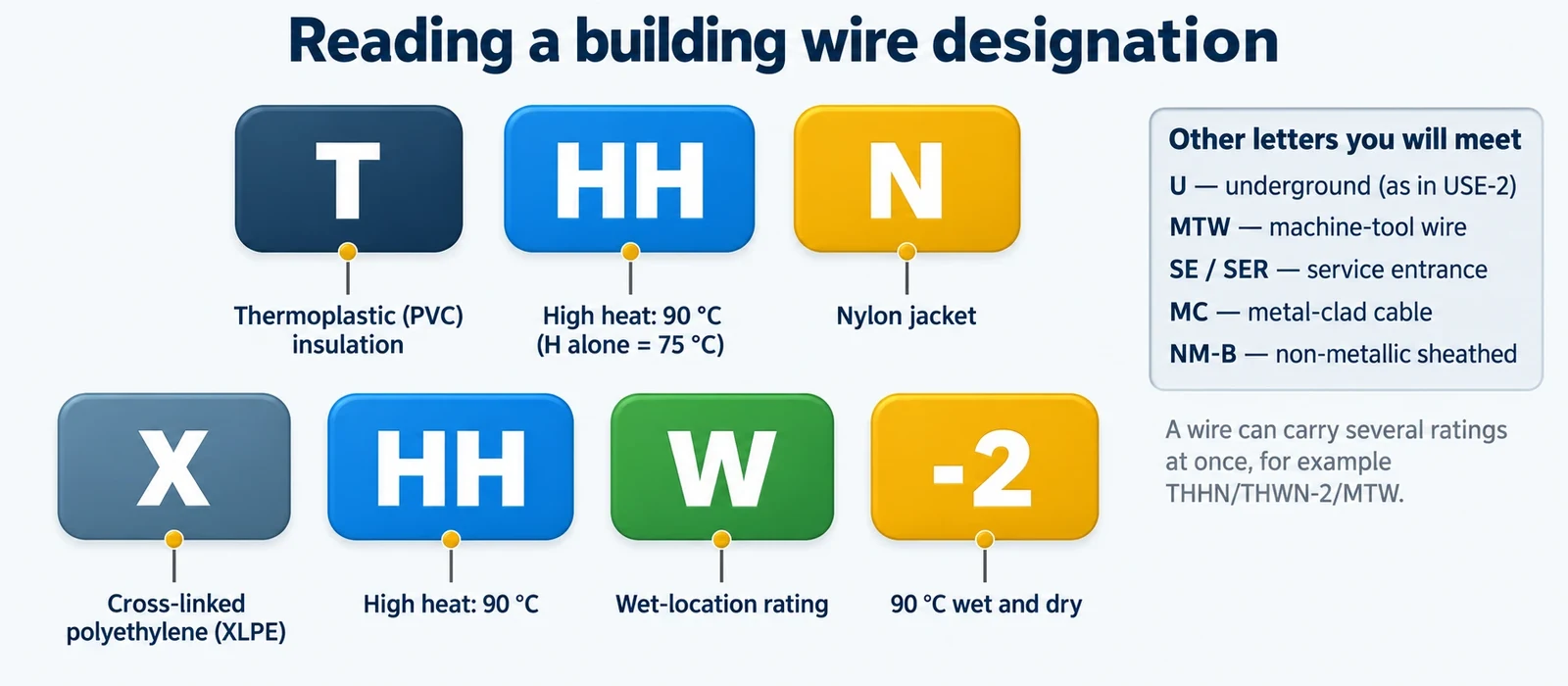
| Letter | Meaning | Example |
|---|---|---|
| T | Thermoplastic insulation (PVC) | THHN, THWN-2 |
| H | Heat resistant, 75 °C | THWN |
| HH | High heat resistant, 90 °C | THHN, XHHW-2 |
| W | Rated for wet locations | THWN-2, XHHW-2 |
| N | Nylon jacket over the insulation | THHN |
| X | Cross-linked polyethylene (XLPE), a thermoset insulation | XHHW-2 |
| -2 | 90 °C in both wet and dry locations | THWN-2, XHHW-2 |
| U | Underground use | USE-2 |
Letter meanings: Service Wire, THHN vs XHHW-2 and RamCorp, THHN vs THWN building wire guide; “U” (underground use) and the 60 °C meaning of a missing “H” from the letter-code appendix of the UL Solutions Wire and Cable Application Guide. Retrieved September 2026.
What is the difference between THHN and THWN-2?
THHN is a dry-location rating of 90 °C; THWN-2 is a rating of 90 °C in wet or dry locations, and one conductor usually carries both. Southwire’s SIMpull spec lists THHN for dry locations up to 90 °C, THWN-2 for wet or dry locations up to 90 °C, and 75 °C where the wire is exposed to oil (Southwire spec 10000). Cerrowire describes its THHN/THWN-2 in the same terms: a 90 °C, 600-volt building wire for wet and dry locations (Cerrowire THHN/THWN-2 sheet).
The practical consequence is about location, not about the wire. NEC 300.5(B) treats the interior of underground raceways as a wet location, and RamCorp’s guide notes that this holds even when the conduit looks dry during installation, so a run that dips below grade needs the W rating on the print (RamCorp). Plain THWN without the -2 is rated 75 °C in wet locations, which lowers the ampacity column the designer may use.
THHN vs XHHW-2: which insulation should you choose?
Choose THHN/THWN-2 for ordinary conduit runs, where its thinner insulation helps fill a raceway; choose XHHW-2 where the site is cold, the circuit needs low leakage current, or it runs above 600 V but not above 1,000 V on wire rated and marked 1,000 V. The difference is the insulation family: THHN/THWN-2 is thermoplastic PVC that depends on its nylon jacket for its rating, while XHHW-2 uses thermoset XLPE that does not remelt with heat (Service Wire).
| Property | THHN/THWN-2 | XHHW-2 | Choose XHHW-2 when |
|---|---|---|---|
| Insulation | PVC with nylon jacket (thermoplastic) | XLPE, no nylon (thermoset) | The specification requires an insulation that does not remelt under heat |
| UL standard | UL 83 | UL 44 | A specification calls for thermoset insulation |
| Voltage | 600 V | 600 V; 1,000 V where rated and marked (optional under UL 44) | The circuit is above 600 V but within 1,000 V and the wire is marked 1,000 V |
| Minimum operating temperature (Service Wire comparison) | −10 °C | −40 °C | Cable is installed or operated in freezing conditions |
| Short-circuit temperature (Service Wire comparison) | 150 °C | 250 °C | Fault levels are high relative to conductor size |
| Dielectric constant | 5.0–6.8 (Service Wire) | 3.1 (Service Wire); 3.5 or less (Encore Wire) | The circuit needs low leakage, for example hospital or sensitive equipment feeders |
Sources: Service Wire, THHN vs XHHW-2 (values as published in Service Wire’s THHN vs XHHW-2 comparison); Encore Wire XHHW-2/RW90 sheet (UL 44, 600 V and 1,000 V, 90 °C wet or dry, dielectric constant 3.5 or less). Retrieved September 2026. Check the datasheet of the brand you buy; minimum temperatures differ between manufacturers.
Is THHN solid or stranded, and how many strands does it have?
THHN is sold solid or stranded in 14 to 10 AWG and is usually stranded from 8 AWG up, with relatively few, thick strands. Cerrowire’s THHN/THWN-2 sheet lists 19 strands for every stranded size from 14 AWG to 4/0 AWG, 37 strands from 250 to 500 kcmil and 61 strands from 600 to 1,000 kcmil, with conductors to ASTM B3, B8 and B787 (Cerrowire). Southwire’s spec uses compressed stranding to ASTM B8 from 4/0 AWG up (Southwire).
That stranding is designed for one job: being pulled into a raceway once and then left alone. Nineteen strands make a conductor that bends around a conduit elbow and stays there. They are not designed to flex thousands of times, which is the job of the next section.
Can THHN be used as a flexible or portable cable?
No. THHN is a fixed-wiring conductor listed to UL 83 (Southwire spec 10000), while portable equipment is connected with a flexible cord or cable of a type listed in NEC Table 400.4 (UL Solutions wire and cable guide): cords such as SO and SOOW are listed to UL 62 (Priority Wire SOOW 12 AWG spec), and portable power cables such as Type W and G-GC to UL 1650. Article 400 allows flexible cords and cables only for the uses in 400.10, and 400.12 forbids using them as a substitute for the fixed wiring of a structure (EC&M on NEC Article 400). The two product families are deliberately kept apart in both directions.
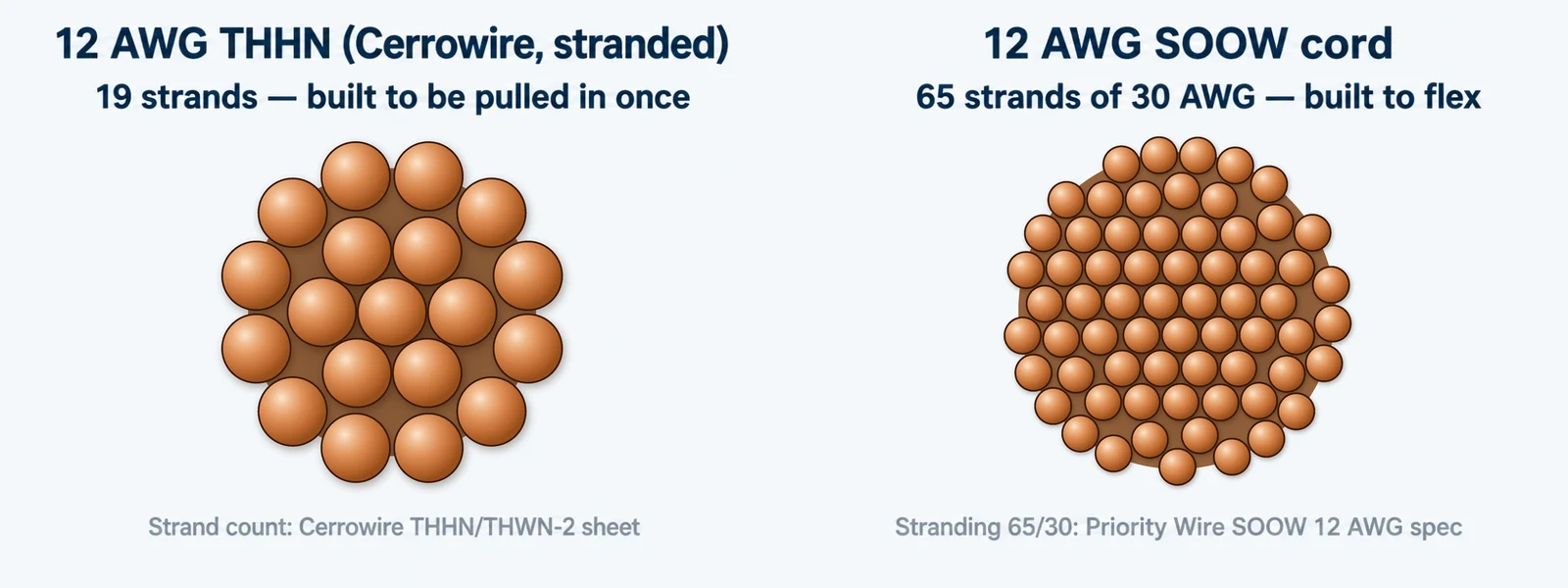
The stranding shows why. Cerrowire’s stranded 12 AWG THHN has 19 strands (Cerrowire); a 12 AWG SOOW cord conductor has 65 strands of 30 AWG wire, with EPDM or EPR insulation, a CPE jacket and a UL 62 listing (Priority Wire SOOW 12 AWG spec, which also lists 600 V and −40 to +90 °C). Fine stranding spreads bending across many small wires, which is what lets a cord survive being dragged, coiled and flexed. Coarse-stranded building wire used on a moving machine or as an extension lead is stiffer, and it is not listed for that duty.
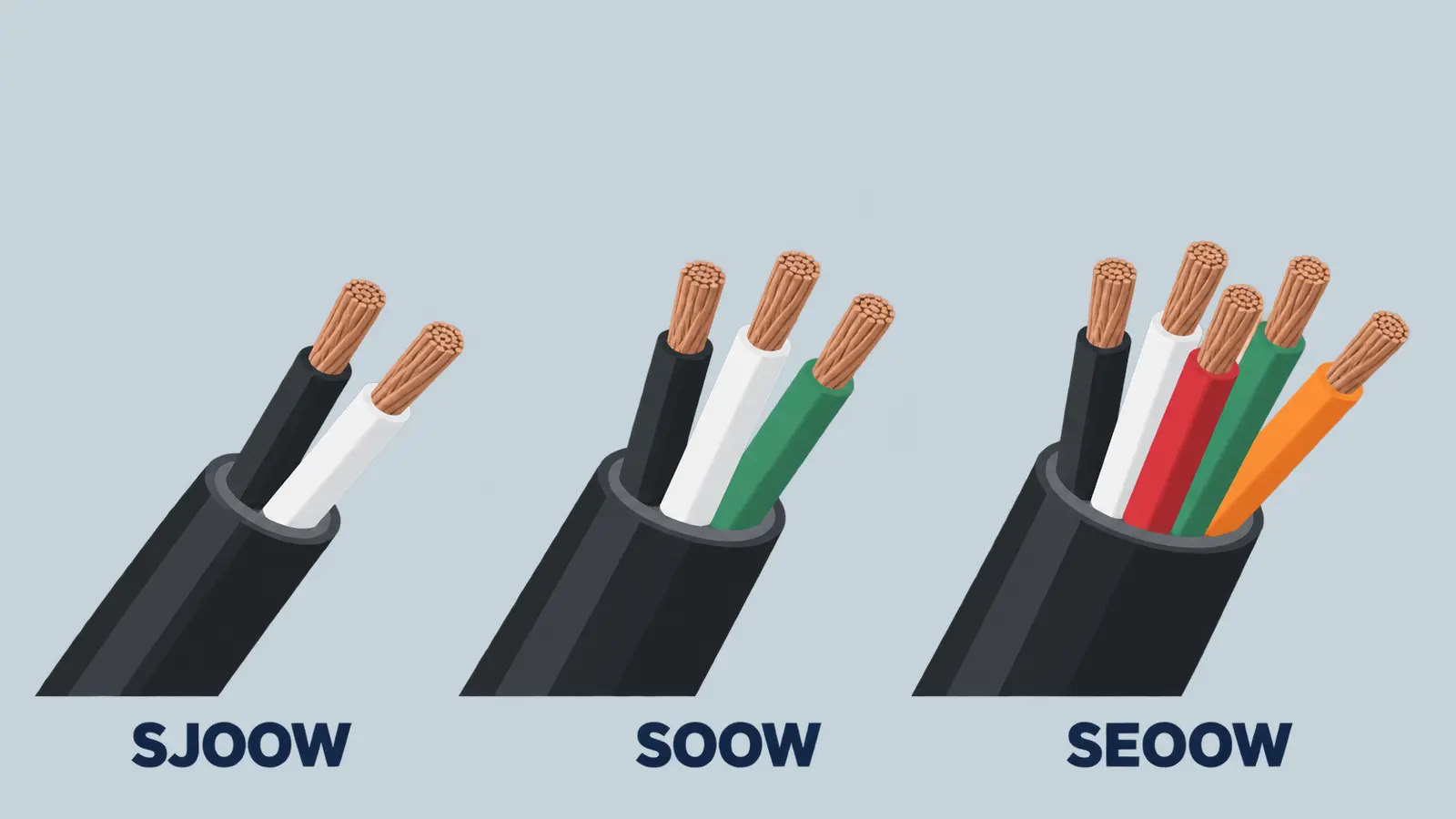
This is the side of the circuit TEBAOFLEX works on. As of August 2026, TEBAOFLEX’s UL certificate UL-US-2449012-4 covers flexible cord (UL category ZJCZ) under UL 62, and its cUL certificate UL-CA-2437036-5 covers the Canadian equivalent under CSA C22.2 No. 49; neither covers UL 83 building wire. For the cord side of the boundary, TEBAOFLEX’s engineering site explains what SO cord is and how to read its markings, and compares SOOW, SJOOW and SEOOW letter by letter.
What is MC cable, and when is it used instead of THHN in conduit?
MC (metal-clad) cable is a factory assembly of insulated conductors inside a metal armor, so the armor does the protective job that conduit does for loose THHN; constructions vary between brands and types. Southwire’s MC-AP, for example, contains PVC-and-nylon THHN/THWN conductors rated 90 °C dry, a full-size bare aluminum grounding/bonding conductor that forms the equipment ground path together with the armor, and interlocked aluminum armor, listed 600 V to UL 1569 and installed under NEC Article 330 (Southwire MC-AP spec).
Contractors choose MC for branch circuits in commercial buildings because one cable replaces a conduit run plus the wires pulled into it. Because the conductors inside are usually THHN/THWN, the letter rules above still apply to them.
What are SER and SEU service entrance cables?
Service entrance (SE) cable carries power from the service drop or underground feeder to the building’s service equipment, and it comes in two main styles (EC&M). SEU has two insulated phase conductors surrounded by a concentric neutral. SER is round: Southwire’s SER has XHHW-2 or THHN/THWN phase conductors, an insulated neutral, a bare ground and a sunlight-resistant PVC jacket, rated 600 V and 90 °C in wet or dry locations, to UL 854 (Southwire SER spec).
The limit that catches people out is underground use. Southwire’s sheet states that SE cables are not permitted underground, with or without a raceway, citing NEC 338.12(A)(2). The “U” in SEU means Style U (unarmored), not underground (Classic Wire & Cable), so SEU is still SE cable and may not be buried. Underground, use USE-2 (the “U” in the letter table) or wet-rated conductors such as THWN-2 or XHHW-2 in conduit.
What are URD and triplex cables?
URD (underground residential distribution) and triplex are mainly utility and supply-side aluminum cables, although URD rated USE-2 is also used for customer-owned underground feeders where the NEC permits. A 600 V URD triplex cable cables two XLPE-insulated phase conductors and an insulated neutral of 1350-H19 aluminum, is rated 90 °C in wet and dry locations for duct or direct burial, and is made to ICEA S-105-692, with a USE-2 rating to UL 854 (Priority Wire URD triplex spec).
“Triplex” on its own usually means the overhead service drop: two XLPE-insulated aluminum conductors twisted around a bare neutral messenger that carries the mechanical load from the pole to the weatherhead, rated 600 V and 90 °C for XLPE insulation, to ICEA S-76-474 (Priority Wire service drop spec). Buyers who order “triplex” should confirm which of the two they mean.
What is MTW wire?
MTW (machine-tool wire) is a PVC-insulated, 600-volt wire listed to UL 1063 for wiring inside machine tools and control cabinets under NFPA 79 and the NEC (Alan Wire MTW/AWM/TEW spec). Southwire rates the MTW use of its THHN/THWN-2 at 90 °C in dry locations and 60 °C where the wire is wet or exposed to oil, for stranded constructions only and with ampacity limited to the 75 °C value under NFPA 79 (Southwire), and Cerrowire’s THHN/THWN-2 is also listed to UL 1063, which is why “THHN/THWN-2/MTW” appears on one print line (Cerrowire).
MTW is still panel and enclosure wire. Once a circuit leaves the cabinet and follows a moving part of the machine, it needs a cable or cord rated for flexing and for the exposure outside the enclosure, not single panel conductors. Communication and fieldbus wiring is a different family again, with its own impedance requirements; the RS-485 cable selection guide covers one common case.
How do you read the print on a THHN/THWN-2 reel?
Read the print from left to right as a list of ratings, then check each one against the location. Cerrowire’s sheet gives this sample legend: “THHN/THWN-2/MTW 250 KCMIL (127 mm2) GRII CT SR 600V (UL) OR AWM” (Cerrowire).
| Marking | Meaning | Source |
|---|---|---|
| THHN/THWN-2/MTW | Carries all three ratings; use the one that matches the location | Cerrowire, Southwire |
| 250 KCMIL (127 mm²) | Conductor size in thousands of circular mils, with the metric area | Cerrowire |
| GRII | Gasoline and Oil Resistant II | Southwire spec 10000 |
| CT | Rated for use in cable tray (Cerrowire: 1/0 AWG and larger) | Cerrowire |
| SR | Sunlight resistant (Cerrowire: black, 8 AWG and larger) | Cerrowire |
| 600V (UL) | Voltage rating; the printed “(UL)” is only a supplemental marking, and the complete UL Listing Mark is on the tag, reel or carton | Cerrowire; UL Solutions guide |
| AWM | Appliance wiring material rating (Cerrowire: UL 758; 105 °C dry when used as appliance wire) | Cerrowire |
| VW-1 | Flame test marking (Cerrowire: 14 AWG through 1 AWG) | Cerrowire |
Sources: Cerrowire THHN/THWN-2 sheet, rev. 12/2023; Southwire SIMpull THHN/THWN-2 spec 10000; UL marking rule from the UL Solutions Wire and Cable Application Guide. Size ranges for each marking are the named manufacturer’s; other brands may differ.
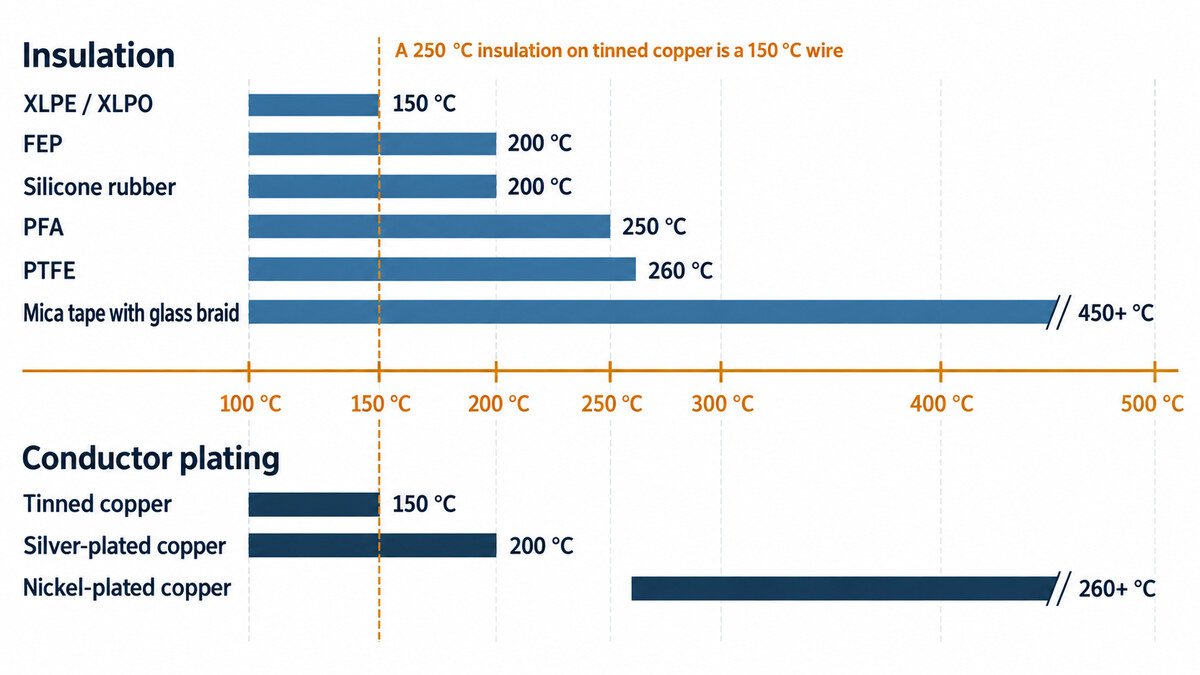
Building wire ratings stop at 90 °C; the 105 °C AWM rating in the table applies only when the wire is used inside appliances. If a field circuit needs more than 90 °C, the insulation family changes, and TEBAOFLEX’s engineering site explains what a 200 °C wire rating really means.
Common mistakes with building wire
- Using THHN-only wire in a wet location. Underground conduit counts as wet; the print must carry THWN, THWN-2 or another W rating (RamCorp).
- Installing THHN without a raceway or burying it. THHN/THWN-2 is not suitable for direct burial (RamCorp). Outside a raceway it is limited to cable tray under NEC 392.10(B)(1): in industrial establishments serviced by qualified persons, and only in sizes listed and marked for tray use, which Cerrowire marks CT from 1/0 AWG up (FastTrax on NEC 392.10, Cerrowire).
- Running SE cable underground. SE cable is not permitted underground, with or without a raceway, under NEC 338.12(A)(2) (Southwire SER spec).
- Sizing NM-B from its 90 °C conductor rating. NEC 334.80 limits NM cable to the 60 °C ampacity, and 334.12 excludes wet and damp locations (ExpertCE on NEC Article 334, 2023 NEC; Southwire Romex SIMpull NM-B spec).
- Using building wire as a cord. Portable equipment needs a flexible cord or cable of a type listed in NEC Table 400.4 (cords such as SO and SOOW to UL 62; portable power cables such as Type W and G-GC to UL 1650), used only as 400.10 allows (EC&M).
THHN and building wire FAQs
Is THHN wire waterproof?
THHN alone is rated for dry locations only. Wire dual-marked THHN/THWN-2 is rated 90 °C in wet locations, which is what an underground or outdoor conduit run requires. Neither rating makes the wire suitable for direct burial or for open runs outside a raceway or a permitted cable tray.
Can THHN wire be buried directly in the ground?
No. THHN/THWN-2 runs in a raceway (or, in sizes marked for it, a permitted cable tray); underground in conduit it needs the W rating. For direct burial, the wire must carry a direct-burial listing such as USE-2, as URD cable does.
Is THWN-2 the same as THHN?
THWN-2 and THHN are separate ratings that usually appear on the same wire. THHN is 90 °C in dry locations; THWN-2 is 90 °C in wet or dry locations and 75 °C where exposed to oil, according to Southwire spec 10000.
Is XHHW-2 better than THHN?
XHHW-2 is different from THHN, not universally better. It has thermoset XLPE insulation with a lower minimum operating temperature and lower leakage, and XHHW-2 rated and marked 1,000 V may be used up to 1,000 V; THHN/THWN-2 has thinner insulation, which helps when filling a raceway (Service Wire, Encore Wire).
What does the “-2” mean on building wire?
The “-2” suffix means the wire is rated 90 °C in both wet and dry locations, as in THWN-2 and XHHW-2; without it, THWN and XHHW are rated 75 °C in wet locations, and some types, such as TW, only 60 °C (RamCorp, Service Wire, UL Solutions guide).
Can I use THHN wire on a portable machine or as an extension cord?
No. Portable equipment needs a flexible cord or cable of a type listed in NEC Table 400.4, such as SO or SOOW cord (UL 62) or Type W portable power cable (UL 1650). THHN is fixed building wire listed to UL 83.
Building wire is chosen once and inspected forever, so it pays to read the print before the reel goes on the pulling rig. If the circuit you are specifying moves or flexes (portable equipment, or a machine part in motion), you are shopping for a flexible cord or an industrial flexible cable rather than building wire: start with the SO cord guide, and send the application, voltage, conductor size and environment through the TEBAOFLEX contact page if you need a flexible construction proposed.