

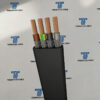
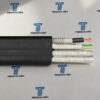
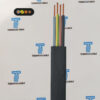
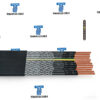
Flat NGFLCGÖU-J (NGFLCGOU-J) Screened Festoon Cable 300/500V for Cranes
NGFLCGÖU-J flat screened festoon cable for cranes, hoists and material handling: 300/500 V, fine-stranded copper, EPR insulation, a tinned copper wire braid with at least 80% coverage and a chloroprene rubber sheath, from 4×1.5 to 24×2.5 mm².
- Rated voltage300/500 V
- Sizes4×1.5 to 24×2.5 mm², flat
- ConductorClass 6 to 25 mm², Class 5 above
- Insulation / sheathEPR / chloroprene rubber (CP)
- ScreenTinned Cu braid, ≥80% coverage
- Min. bending radius5×D fixed, 10×D moving
- Conductor temperature90 °C (short circuit 250 °C)
- ApplicationFestoon cranes, hoists, VFDs
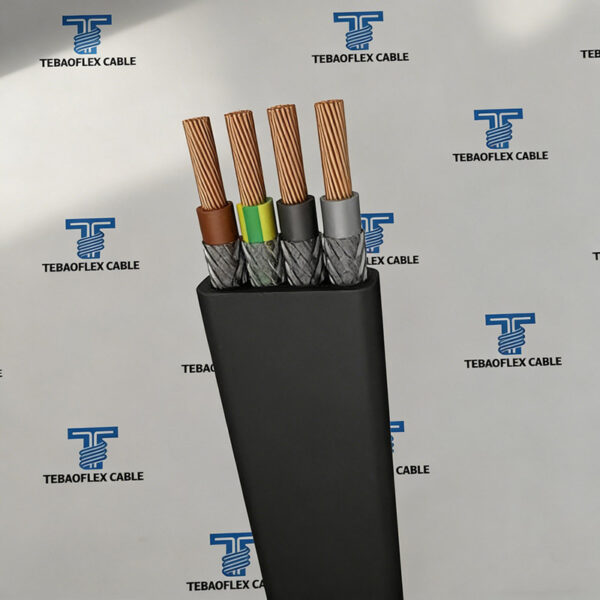
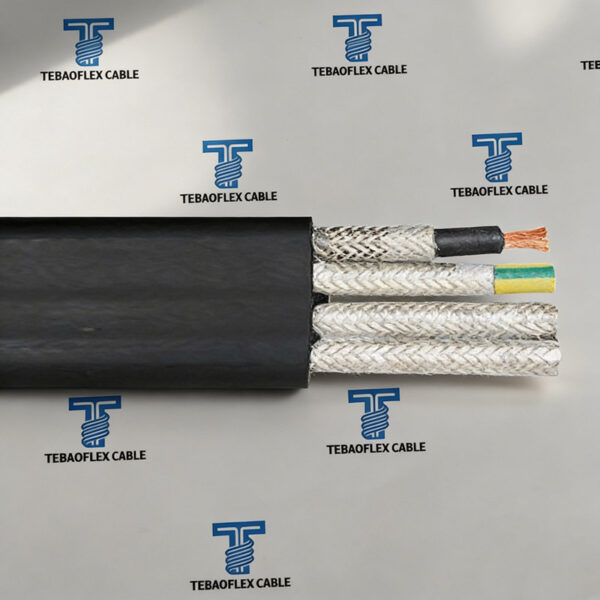
NGFLCGÖU-J is a flat, screened rubber trailing cable for festoon systems. Its cores of fine-stranded copper with EPR insulation lie side by side, a tinned copper wire braid with at least 80% coverage surrounds them, and a chloroprene (CP) rubber sheath closes the cable. It is rated 300/500 V and runs on the festoon trolleys of cranes, gantries and hoists, and on conveyors, trolleys and machine tools in automation lines.
NGFLCGÖU-J is the screened version of NGFLGÖU-J: voltage, insulation, sheath and bending radius are the same, and the braid adds electromagnetic protection. Use it where frequency converters, servo motors or mixed power and signal circuits share the festoon, in ports, mines, steel mills and other sites with strong interference. Where no converter is involved, the unscreened NGFLGÖU-J is the lower-cost choice.
Browse the port crane cable category for related cables.
Application & Features
Selection overview
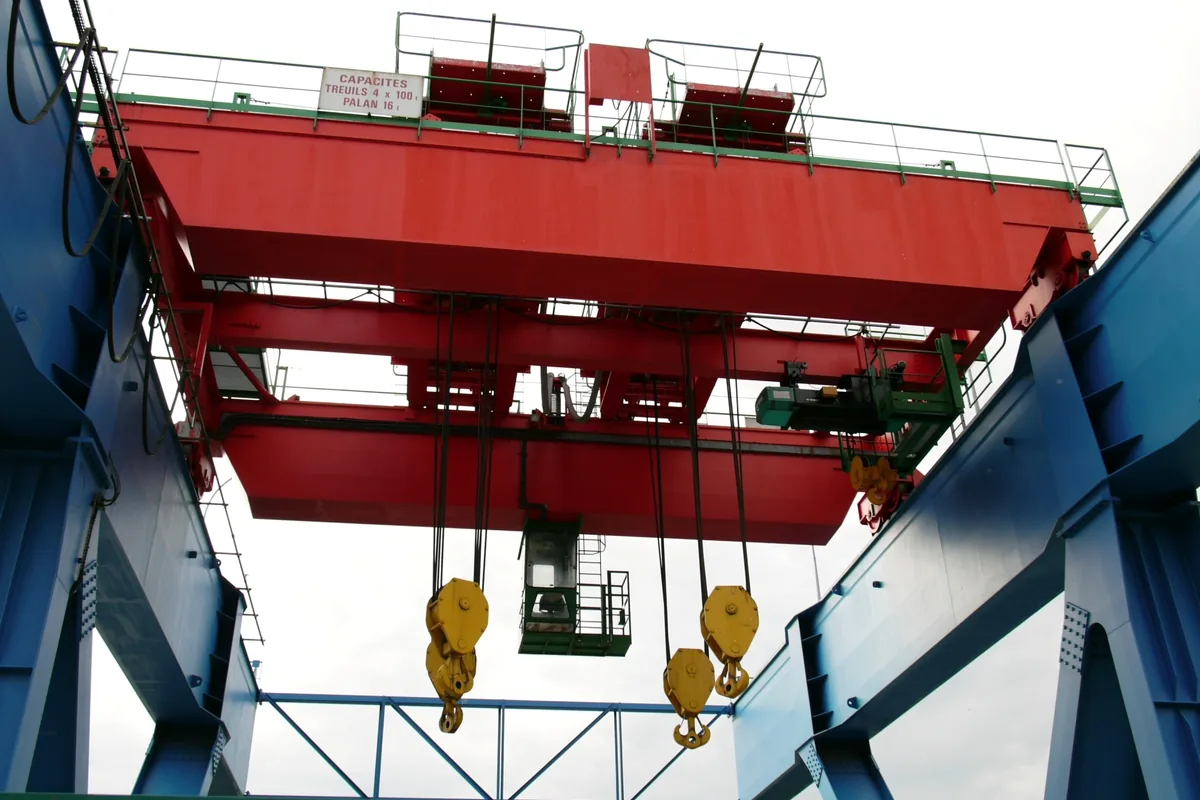
In a festoon system the cable hangs in loops from small trolleys that run along a track or beam. Each time the crane or its trolley travels, the loops fold together and open again, so the cable bends again and again in one plane. A flat cable suits this duty: it folds neatly in one direction, several flat cables can share the same trolley saddle, and the parallel cores share the bending load. NGFLCGÖU-J brings that construction to circuits that also need a screen, typically the motor leads from a frequency converter to hoist or travel drives, and servo circuits on automated cranes and handling systems.
The braid only works when it is earthed: connect it to earth as the drive manufacturer's EMC instructions require, usually at the drive and at the motor or junction box. The screen also lets one flat cable carry power and control cores together without picking up interference from the motor circuit. Typical installations are port cranes, overhead cranes in steel mills and workshops, mine hoisting and conveying equipment, and material handling lines.
- Festoon cranes and hoistsFlat trailing cable for festoon trolleys on cranes, gantries and hoists.
- Converter and servo drivesTinned copper braid with at least 80% coverage against interference from VFD and servo circuits.
- Power and control togetherScreened build for mixed power and control cores in one festoon cable.
- Automation and handlingConveyors, trolleys and machine tools in ports, mines and steel mills.
Specifications
Technical data
Values from the current TEBAOFLEX NGFLCGÖU-J datasheet. The final construction is confirmed on the approved datasheet for your order.
NGFLCGÖU-J electrical, thermal and material data
| Parameter | Value |
|---|---|
| Rated voltage | 300/500 V |
| Conductor up to 25 mm² | Class 6 extra-fine stranded copper |
| Conductor over 25 mm² | Class 5 flexible stranded copper |
| Insulation | EPR (ethylene propylene rubber) |
| Screen | TCWB, tinned copper wire braid, ≥80% coverage |
| Outer sheath | CP rubber (chloroprene) |
| Maximum conductor operating temperature | 90 °C |
| Maximum conductor short-circuit temperature | 250 °C |
| Temperature range, fixed | -50 °C to +90 °C |
| Temperature range, mobile | -30 °C to +90 °C |
| Minimum bending radius, fixed | 5 × overall diameter |
| Minimum bending radius, moving | 10 × overall diameter |
| Screen earthing | Braid to be earthed to block electromagnetic interference |
NGFLGÖU-J vs NGFLCGÖU-J festoon cable
| Item | NGFLGÖU-J (unscreened) | NGFLCGÖU-J (screened) |
|---|---|---|
| Voltage | 300/500 V | 300/500 V |
| Conductor | Class 6 extra-fine stranded copper | Up to 25 mm²: Class 6 extra-fine stranded copper; over 25 mm²: Class 5 flexible stranded copper |
| Insulation | EPR (ethylene propylene rubber) | EPR (ethylene propylene rubber) |
| Shielding | None | TCWB tinned copper braid (≥80% coverage) |
| Outer sheath | CP rubber (chloroprene) | CP rubber (chloroprene) |
| Working environment | Normal electromagnetic field | Severe electromagnetic interference |
| Cost | Lower | Higher |
| Typical use | General reeling power and control circuits | Frequency conversion and servo systems |
| Minimum bending radius | Fixed: 5 × overall diameter; moving: 10 × overall diameter | Fixed: 5 × overall diameter; moving: 10 × overall diameter |
| Temperature rating | Fixed: -40 °C to +90 °C; flexed: -35 °C to +90 °C | Fixed: -50 °C to +90 °C; mobile: -30 °C to +90 °C |
NGFLCGÖU-J screened: dimensions and weight
| Size (cores × mm²) | Min. height × width (mm) | Max. height × width (mm) | Nominal weight (kg/km) |
|---|---|---|---|
| 4×1.5 | 6.2 × 17.8 | 7.2 × 20.4 | 220 |
| 4×2.5 | 7.2 × 21.6 | 8.3 × 24.8 | 320 |
| 4×4 | 10.1 × 27.8 | 11.6 × 31.9 | 505 |
| 4×6 | 10.1 × 29.8 | 11.6 × 34.1 | 605 |
| 4×10 | 11.0 × 34.6 | 12.7 × 39.6 | 840 |
| 4×16 | 13.0 × 39.8 | 14.9 × 45.7 | 1180 |
| 4×25 | 14.4 × 45.1 | 16.5 × 51.7 | 1605 |
| 4×35 | 16.3 × 52.8 | 18.7 × 60.5 | 2520 |
| 4×50 | 19.1 × 61.8 | 21.7 × 66.0 | 2860 |
| 4×70 | 20.8 × 71.8 | 24.75 × 75.8 | 4790 |
| 4×95 | 23.25 × 80.2 | 27.25 × 84.0 | 5950 |
| 4×120 | 28.05 × 91.8 | 31.05 × 96.8 | 7750 |
| 5×1.5 | 5.95 × 26.55 | 7.95 × 28.55 | 440 |
| 5×2.5 | 7.25 × 30.65 | 9.25 × 32.65 | 590 |
| 5×4 | 8.55 × 34.75 | 10.55 × 36.75 | 770 |
| 5×6 | 9.15 × 37.75 | 11.15 × 39.75 | 920 |
| 5×10 | 10.65 × 45.25 | 12.65 × 47.25 | 1290 |
| 5×25 | 14.85 × 61.45 | 16.85 × 63.45 | 2490 |
| 7×1.5 | 5.95 × 34.85 | 7.95 × 36.85 | 570 |
| 7×2.5 | 7.25 × 40.35 | 9.25 × 42.35 | 790 |
| 7×4 | 8.55 × 45.85 | 10.55 × 47.85 | 1010 |
| 7×6 | 9.15 × 50.05 | 11.15 × 52.05 | 1220 |
| 7×10 | 10.0 × 57.6 | 12.0 × 59.6 | 1550 |
| 7×25 | 15.0 × 82.8 | 17.0 × 84.8 | 3350 |
| 7×35 | 16.3 × 94.8 | 18.7 × 99.8 | 4500 |
| 8×1.5 | 7.2 × 34.6 | 8.3 × 39.6 | 470 |
| 8×2.5 | 7.25 × 43.2 | 9.25 × 45.2 | 830 |
| 10×1.5 | 7.55 × 47.9 | 8.55 × 49.9 | 810 |
| 12×1.5 | 8.1 × 52.0 | 8.0 × 54.0 | 796 |
| 12×2.5 | 7.75 × 65.1 | 9.6 × 69.0 | 1020 |
| 24×1.5 | 8.15 × 112.6 | 9.15 × 114.6 | 1930 |
| 24×2.5 | 9.05 × 130.6 | 11.05 × 132.6 | 2760 |
NGFLGÖU-J unscreened: dimensions, weight and tensile strength
| Size (cores × mm²) | Nominal width (mm) | Nominal height (mm) | Nominal weight (kg/km) | Tensile strength (N) |
|---|---|---|---|---|
| 4×1.5 | 17.5 | 6.2 | 200 | 90 |
| 4×2.5 | 21.1 | 7.5 | 280 | 150 |
| 4×4 | 26.1 | 9.1 | 410 | 240 |
| 4×6 | 29.1 | 9.5 | 600 | 360 |
| 4×10 | 33.1 | 11.1 | 800 | 600 |
| 4×16 | 37.8 | 12.9 | 1150 | 960 |
| 4×25 | 49.5 | 15.1 | 1700 | 1500 |
| 4×35 | 54.9 | 17.1 | 2200 | 2100 |
| 4×50 | 62.8 | 18.9 | 3000 | 1500 |
| 4×70 | 71.2 | 22.1 | 3910 | 4200 |
| 4×95 | 79.8 | 24.8 | 5300 | 5700 |
| 4×120 | 85.8 | 27.2 | 6400 | 7200 |
| 5×1.5 | 21.5 | 6.2 | 240 | 112 |
| 5×2.5 | 27.1 | 7.5 | 332 | 187 |
| 5×4 | 32.1 | 9.1 | 560 | 300 |
| 5×6 | 35.1 | 9.5 | 650 | 450 |
| 5×10 | 44.1 | 11.1 | 1135 | 750 |
| 5×16 | 49.8 | 12.9 | 1450 | 1200 |
| 5×25 | 59.8 | 16.1 | 2200 | 1875 |
| 7×1.5 | 29.1 | 6.2 | 360 | 157 |
| 7×2.5 | 34.9 | 7.5 | 520 | 262 |
| 7×4 | 41.9 | 9.1 | 700 | 420 |
| 7×6 | 42.1 | 9.5 | 850 | 630 |
| 7×25 | 79.7 | 16.1 | 2930 | 2625 |
| 7×35 | 88.2 | 17.1 | 3820 | 3675 |
| 8×1.5 | 31.5 | 6.2 | 370 | 180 |
| 8×2.5 | 39.1 | 7.5 | 550 | 300 |
| 10×1.5 | 39.9 | 6.5 | 460 | 225 |
| 10×2.5 | 47.9 | 8.1 | 680 | 375 |
| 12×1.5 | 47.1 | 6.5 | 620 | 270 |
| 12×2.5 | 56.1 | 8.1 | 800 | 450 |
| 12×1.5 | 4.2 | 6.5 | 900 | 360 |
| 12×1.5 | 55.1 | 12.5 | 1300 | 540 |
| 12×2.5 | 68.2 | 16.2 | 1480 | 900 |
Selection note: before ordering, ask our engineers to confirm the maximum tensile load of the screened NGFLCGÖU-J size you need, the minimum ambient temperature for your crane, and the festoon travel speed and loop length the cable has to handle.
Standards & References
Applicable standards and compliance
- Type designationNGFLCGÖU-J is the braid-screened type in the NGFLGÖU family of flat rubber festoon cables; -J denotes a core set with a green/yellow protective core.
- ConductorClass 6 extra-fine stranded copper up to 25 mm²; Class 5 flexible stranded copper above 25 mm².
- Voltage scopeRated 300/500 V for power and control circuits on festoon systems.
- EMC screenTinned copper wire braid with at least 80% coverage; the braid is earthed to block electromagnetic interference.
- ApprovalsThird-party certificates, test reports and marking requirements are confirmed and quoted per order.
Construction
Material and build-up
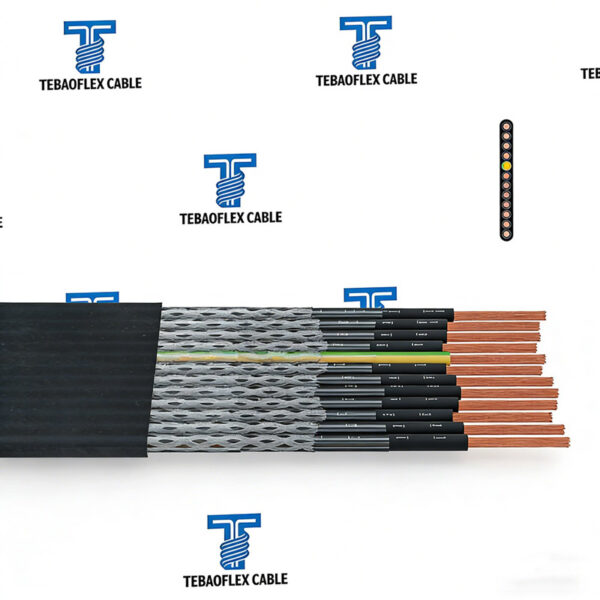
NGFLCGÖU-J is a flat cable. The insulated cores lie side by side in one plane, so the cable folds in one direction in the festoon loops. A tinned copper wire braid covers the core layer, and a chloroprene rubber sheath is applied over the braid.
- Conductor: copper, Class 6 extra-fine stranded up to 25 mm² and Class 5 flexible stranded above 25 mm², for repeated bending in the festoon loops.
- Insulation: EPR (ethylene propylene rubber) on each core, for a 90 °C conductor operating temperature.
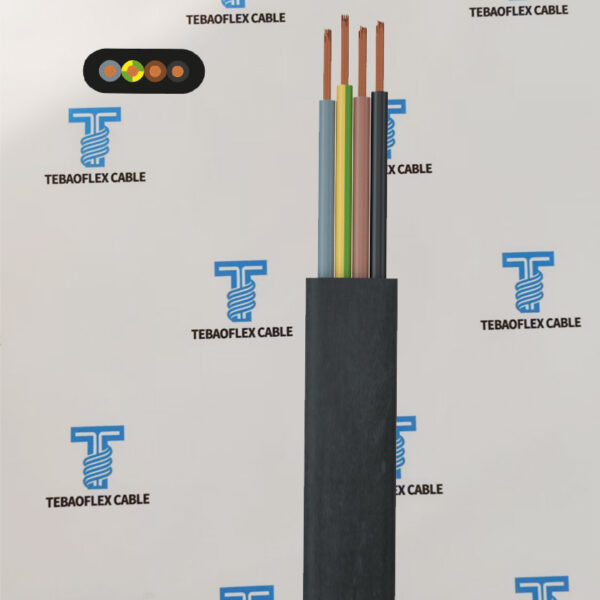
- Core layout: cores laid parallel in one plane; -J versions include a green/yellow protective core.
- Screen: tinned copper wire braid (TCWB) with at least 80% coverage, earthed to block electromagnetic interference.
- Outer sheath: CP rubber (chloroprene) over the braid.
FAQ
Selection questions
What does NGFLCGÖU-J mean, and how does it differ from NGFLGÖU-J?
Both are flat (FL) rubber festoon cables with EPR insulation and a chloroprene sheath, rated 300/500 V. The extra C in NGFLCGÖU-J marks the copper braid screen, here tinned copper wire with at least 80% coverage. The -J suffix means the core set includes a green/yellow protective conductor. The name is also written NGFLCGOU-J or NGFLCGOEU-J where the letter Ö is not available.
When do I need the screened version?
Choose NGFLCGÖU-J when the festoon carries motor leads from a frequency converter or servo drive, when power and control cores run in the same cable, or when the site has strict EMC requirements, as on many port and steel mill cranes. For standard festoon circuits without converters, the unscreened NGFLGÖU-J does the same mechanical job at lower cost. Earth the braid as the drive manufacturer's EMC instructions require; an unearthed braid does not block interference. Other crane and reeling cables are in the port crane cable category.
How do I plan the festoon with this cable?
Use the dimension tables to check that cable height and width fit the trolley saddles, and keep the loop radius at or above 10 × the overall diameter in moving sections (5 × in fixed sections). The weight per km sets the load on each trolley. Send the travel length, speed and number of loops, and our engineers check the cable against the festoon design.
Can I get samples, a small order or custom printing?
Yes. Free festoon cable samples are available for checking quality and construction, with shipping paid by the buyer. The general minimum order is 50 m. Your company name or brand can be printed on the cable sheath and on the drums. Warranty terms, generally 6 months to 1 year, depend on the cable type and the actual application.
What should I send for a quotation?
Send the number of cores and cross-section (for example 4×16 or 12×1.5), screened or unscreened version, length per crane and number of cranes, the drive type (frequency converter or direct-on-line), the ambient temperature range and any sheath printing you need.
Request this cable.
Send cores and cross-section, screened or unscreened version, length, drive type, ambient temperature range and any sheath printing.
Quality Assurance
Testing at every stage in our own workshop and laboratory, from incoming copper to the packed drum.

Raw Material Inspection
Every batch of copper rod, rubber compound and reinforcing material is checked before it reaches the line.
- Copper: conductor resistance, elongation and surface condition on incoming rod and drawn wire
- EPR, CPE, PUR and silicone compounds: hardness, tensile strength, elongation and ageing samples from each mix
- Suppliers and batch numbers are recorded so every drum can be traced back to its materials
Manufacturing Process Control
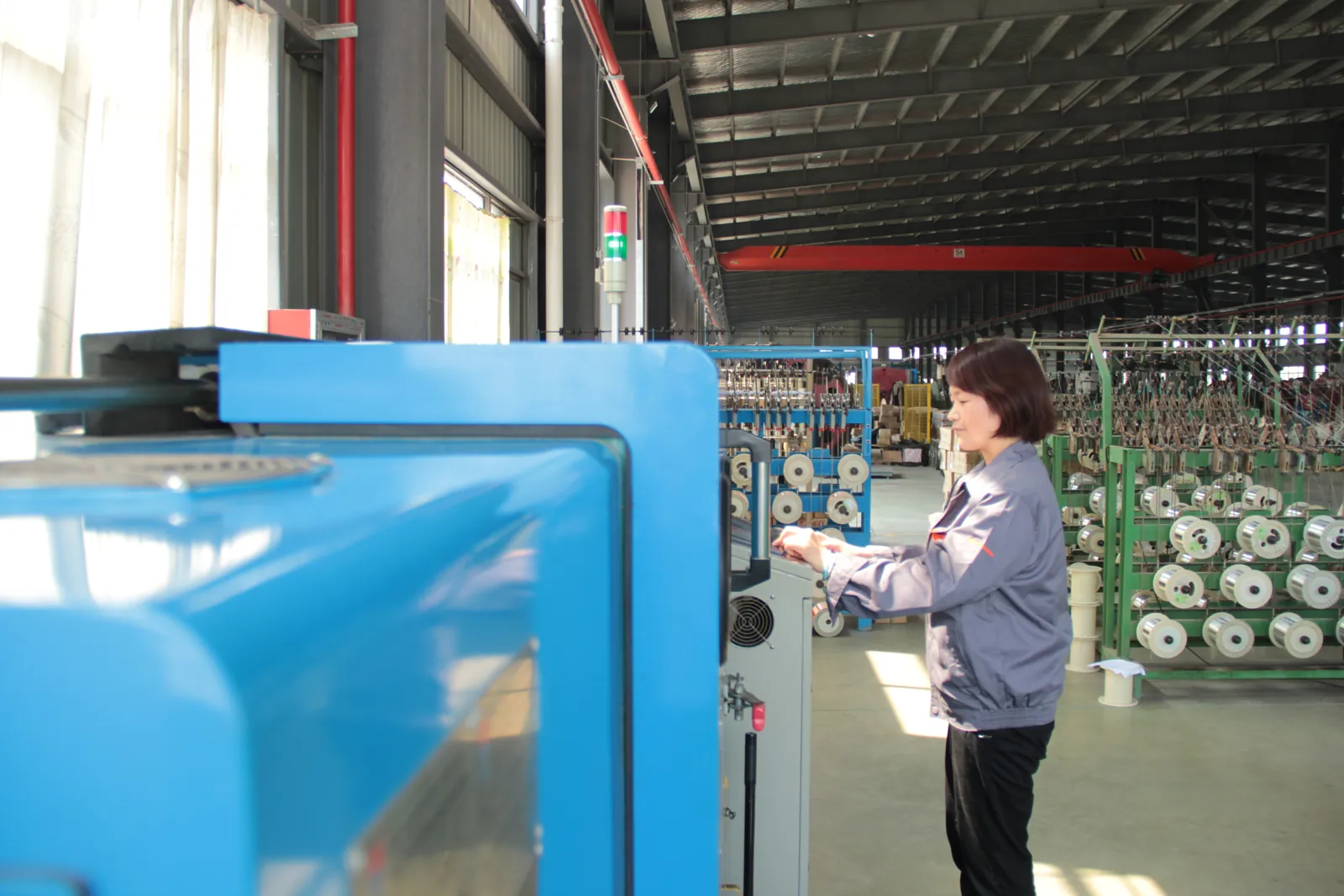
Stranding, insulation extrusion, core assembly and sheathing run under recorded process parameters.
- Class 5/6 stranding with lay length and tension monitored for trailing and reeling flexibility
- Continuous-vulcanisation extrusion with wall thickness and spark tests logged on every length
- Operators sign off each stage before the cable moves to the next machine
Electrical Testing
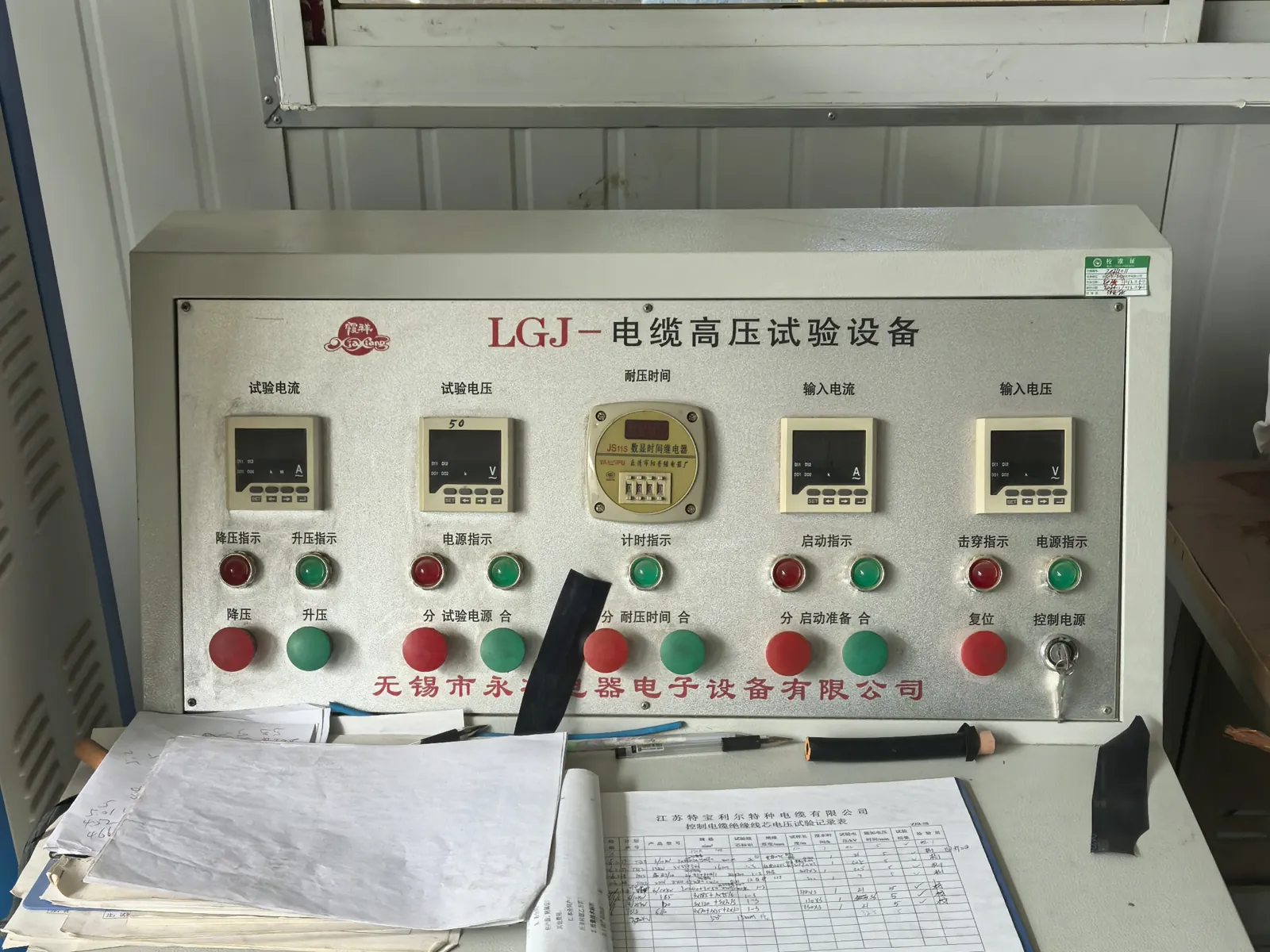
Finished lengths go through the routine tests required by the referenced VDE, ICEA, IEC or NEK standard.
- Conductor resistance and insulation resistance on every length
- Voltage withstand (3.5 kV and higher) and partial-discharge measurement in the shielded HV laboratory
- Screen and pilot-core continuity checks for mining and reeling constructions
Mechanical and Ageing Tests
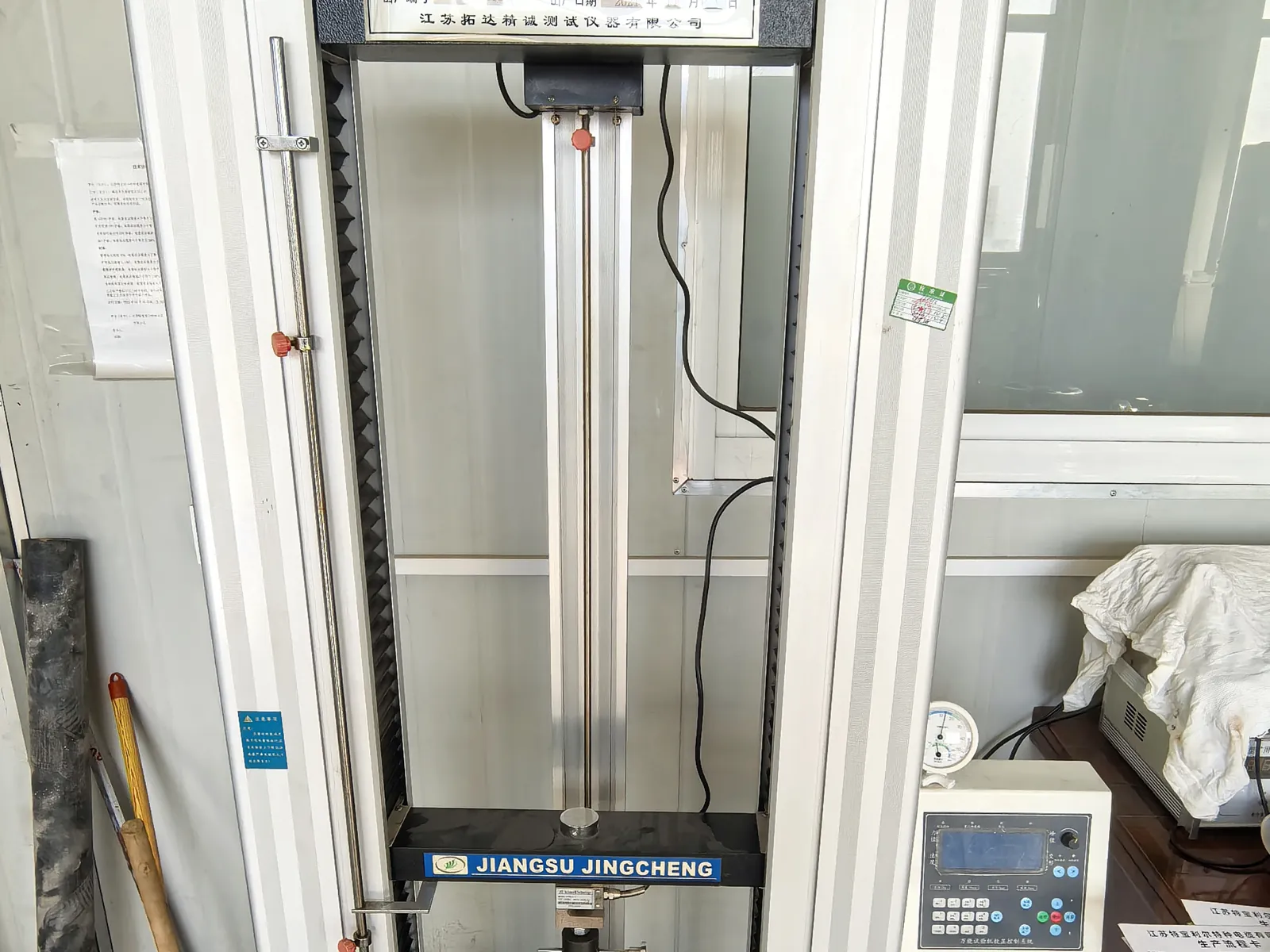
Samples from production are tested for the duty a mining, crane or submersible cable will actually see.
- Tensile strength and elongation of insulation and sheath before and after ageing
- Hot-set, ozone, oil-immersion and low-temperature bending tests
- Constant-temperature water bath for insulation resistance of submersible constructions
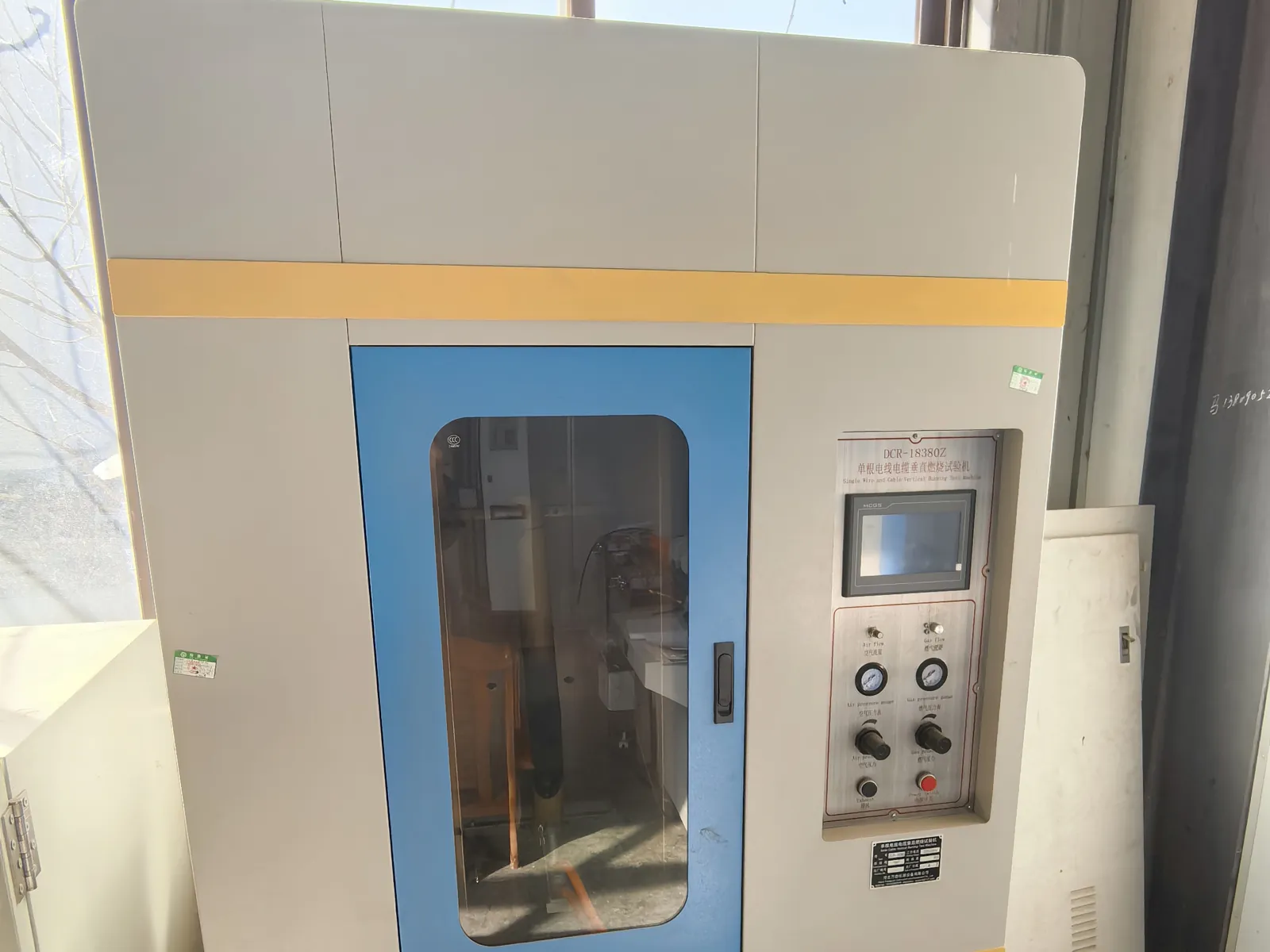
Flame Test and Final Inspection
Before packing, the cable is checked against the order and the flame-performance requirement of its standard.
- Single-cable vertical flame test to IEC 60332-1-2 where specified
- Metre marking, printing, drum length and appearance inspection
- Test report and packing list issued with every shipment
Related products
-
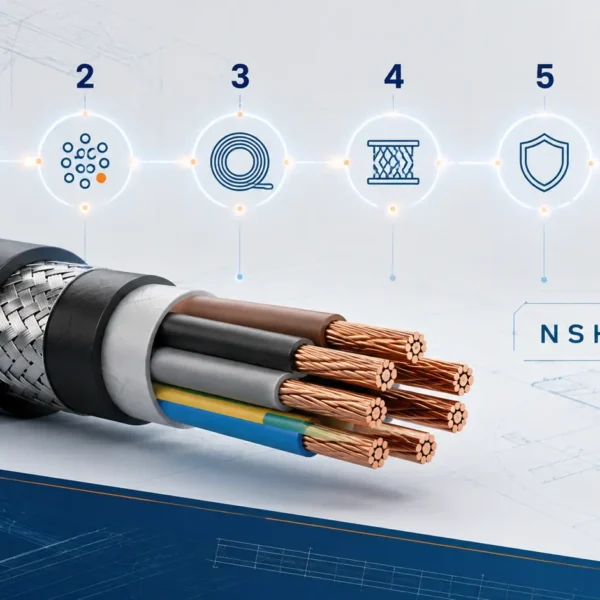
Olflex SMK NSHTOU J Rubber Crane Reeling Cable
-
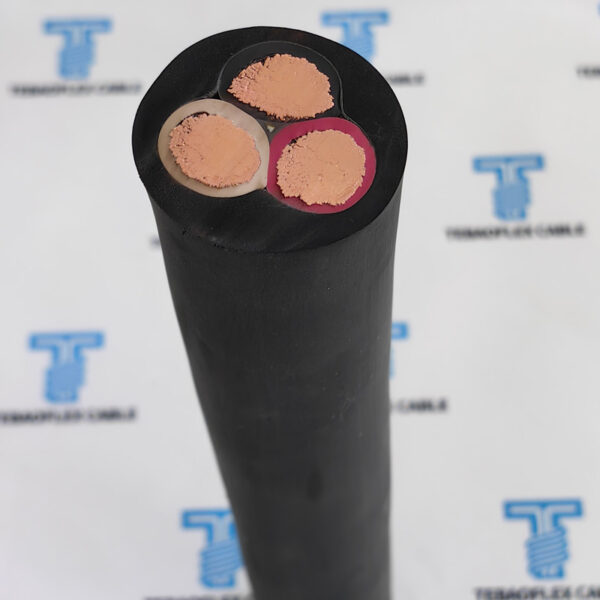
600V 2PNCT-SB-3C-T-B PNCT Cable for Crane Reeling & Festoon
-
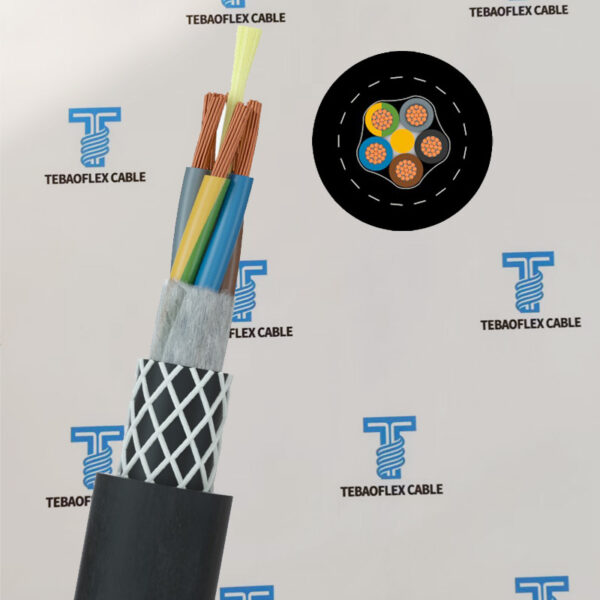
Trommelflex PUR-C-HF-J EMC Festoon Cable 12×2 5 18×2 5 4×16
-
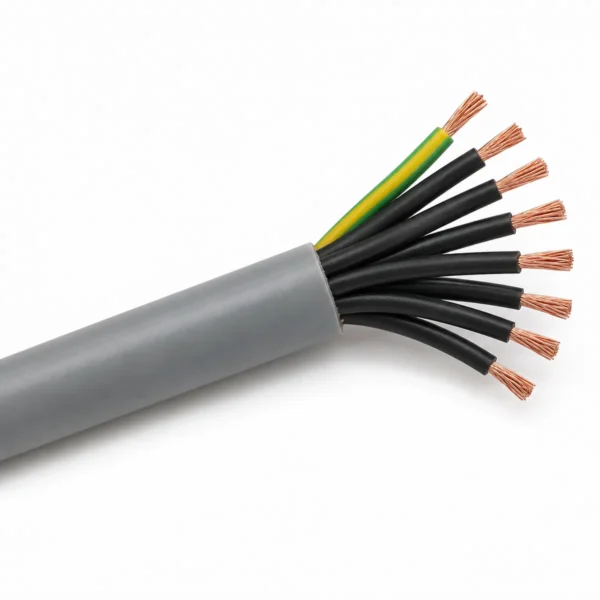
PUR-JZ Control Cable
-
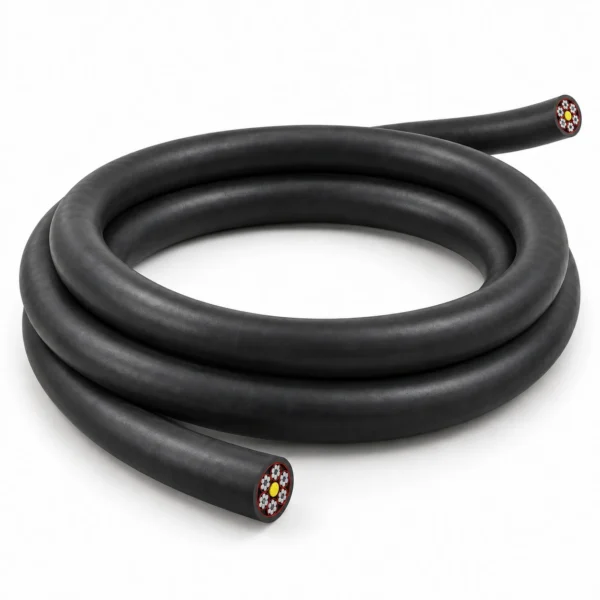
3GRDGÖU Basket Cable | UTVFLEX-BASKET & BASKETHEAVYFLEX Alternatives
-
Flat FNGFLGOU-J (NGFLGOEU, NGFLGÖU-J) Flexible Rubber Festoon Cable for conveyors, trolleys
-
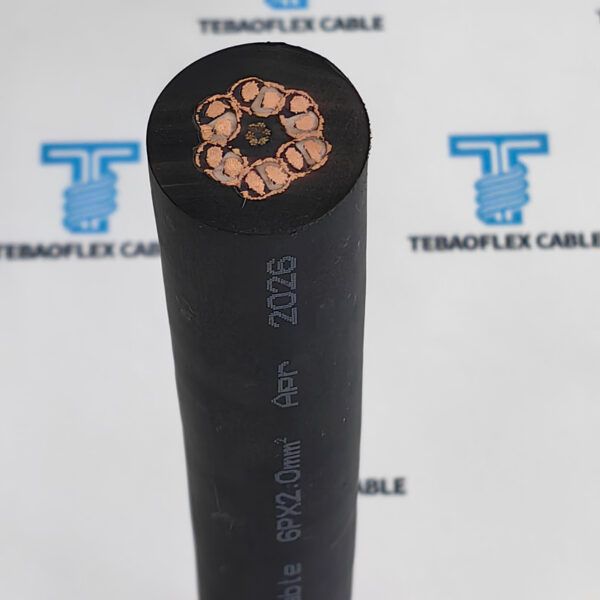
600V CUR-2PNCT-3PNCT CUR-2PNCT-3PNCT-SB Cable for port crane festoon
Need Pricing for This Cable?
Tell us the length, cores, cross-section and delivery country and we will reply with a quotation and datasheet.