Tinned Copper Wire vs Bare Copper: How to Choose a Copper Conductor
Tinned vs bare copper wire explained: what tinning does, when to specify it, ETP vs oxygen-free copper, solid vs stranded, and how to spot CCA.

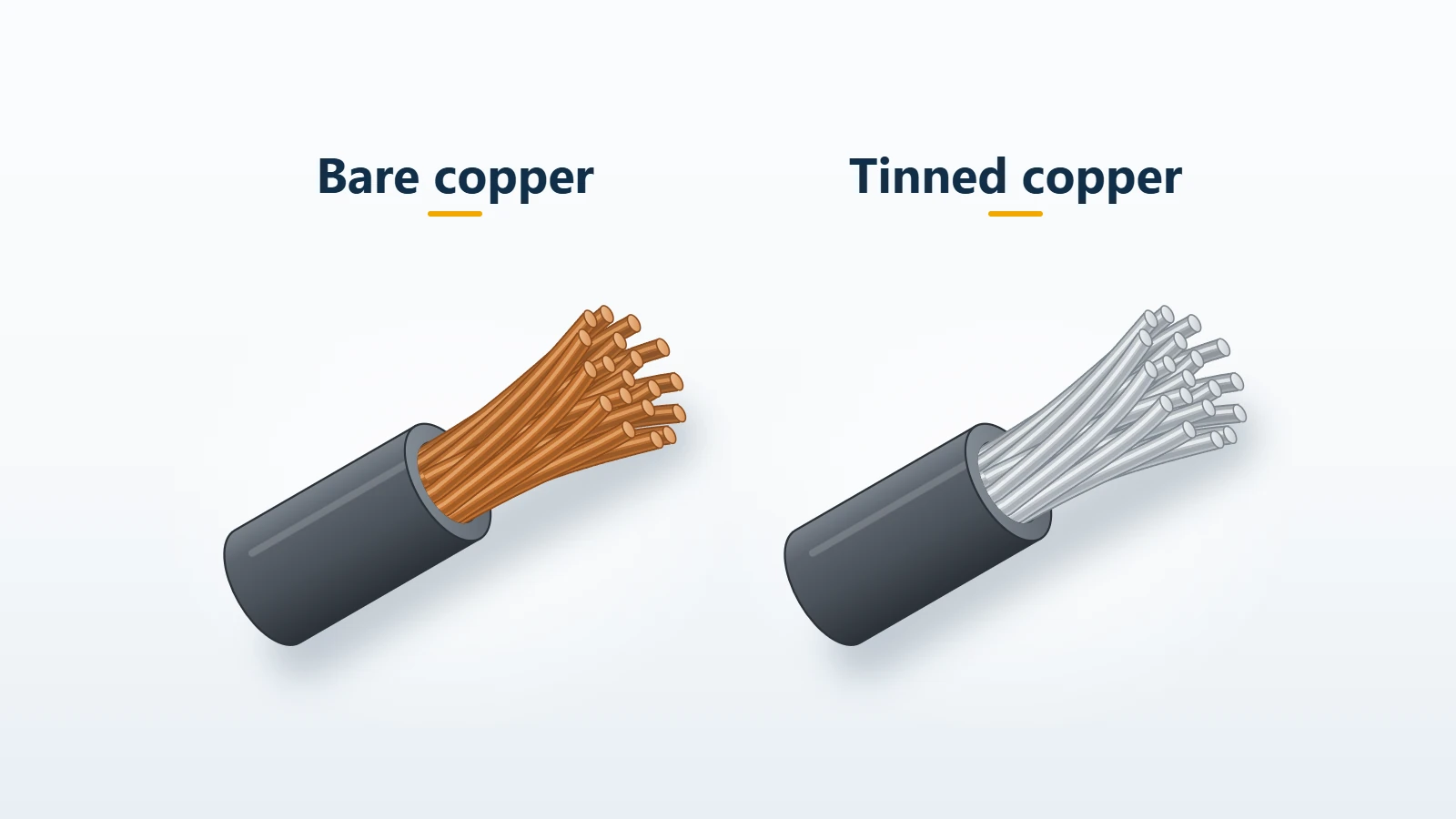
Use tinned copper wire on continuously damp or corrosive sites or for soldered ends; use bare (plain) copper in dry, fixed installations with crimped or clamped ends. A copper conductor is the copper wire, or bundle of wires, that carries current inside a cable. Tinned copper wire has a thin coating of tin on the copper, and bare copper wire has no coating. The conductor is the first layer in the parts of an electrical cable.
Copper wire sold for crafts, or by the foot for house wiring, is outside this guide. This guide covers the conductors inside industrial, control, data and EV cables.
Size, the conductor cross-section, comes first and depends on the load and the installation. After size, four choices define the conductor.
Four choices that define a copper conductor
| Choice | Common options | What it decides | Section |
|---|---|---|---|
| Grade | ETP copper (UNS C11000); oxygen-free copper (C10200, C10100) | Purity, oxygen content and behavior when brazed or welded | ETP vs oxygen-free copper |
| Temper | Annealed (soft), medium-hard-drawn, hard-drawn | How flexible or stiff each wire is | Bare copper wire |
| Surface | Bare (plain); tinned; silver- or nickel-coated | Corrosion resistance and solderability | Tinned vs bare |
| Construction | Solid, stranded, fine-stranded | Flexibility and how the end is terminated | Stranded vs solid |
Sources: tempers and coatings, ASTM B1-13(2026) (hard-drawn), B2-13(2026) (medium-hard-drawn), B3-13(2024) (soft or annealed), B33-10(2020)e1 (tin-coated soft or annealed), B246-15(2021) (tinned hard-drawn and medium-hard-drawn), B298-12(2024) (silver-coated) and B355-11(2024) (nickel-coated) copper wire, titles and scopes; grades, Copper Development Association data pages for C10100, C10200 and C11000.
What is tinned copper wire?
Tinned copper wire is copper wire with a thin coating of tin, made in soft (annealed) and harder tempers. Stranded tinned conductors to ASTM B8, B172, B173 and B174 are made from tin-coated wires, so every strand carries its own coating.
The tin does two jobs. It protects the copper from the moisture and corrosive elements that attack bare copper, which helps prevent premature cable failure. It also makes the surface more receptive to solder than bare copper. Easier stripping was a third, historical reason for tinning.
Tinning began as protection against the insulation itself. Older rubber insulations were cured with sulfur, which reacted with bare copper to form copper sulfide and turned the conductor black. Today nearly all synthetic rubber insulations are cured with organic peroxides, so most cables no longer need tin for that reason. Sulfur-containing compounds such as chlorosulfonated polyethylene (CSPE) are the exception.
Tinned soft copper wire is specified to ASTM B33 in North America, and tinned hard-drawn and medium-hard-drawn wire to ASTM B246. The comparison table below lists the stranding standards and the European side.
Silver- and nickel-coated copper wire have their own standards, ASTM B298 and B355; for temperature ratings, see high-temperature wire insulation ratings.
Sources: purpose and history of tinning, Consulting-Specifying Engineer, “Power Cable: To Tin or Not to Tin” (2005), Okonite, Technical News 36, “Tinned Coated Copper Conductors: Why is it still in Specifications?” (September 2021) and Southwire, “Tinned Conductors” (2019, updated 2022); corrosion protection, Service Wire, Bare Copper; tin-coated wires in stranded conductors, ASTM B8-23, B172-17(2024), B173-17(2024) and B174-17(2024) (titles and scopes); wire standards, ASTM B33, B246, B298 and B355.
What is bare copper wire used for?
Bare copper wire is used for grounding and bonding conductors and overhead lines, and as plain copper it forms the conductor of many insulated cables. In the coating sense, bare copper is copper wire with no tin or other metal coating.
“Bare” has two meanings, so read it in context. ASTM B3 wire is uncoated, and its tin-coated counterpart is ASTM B33. The US stranding standards, by contrast, use bare to mean uninsulated: ASTM B8 covers bare stranded conductors made from either uncoated or tin-coated wires. Some makers sell stranded bare copper in bare or tinned versions.
European standards such as EN 13602 call uncoated wire “plain” and coated wire “tinned”. In IEC terms, a wire with a thin layer of tin or tin alloy is “metal-coated”. A bare conductor has no insulation, so it is not a core; see the difference between a wire, a cable and a cord.
Soft (annealed) copper is the flexible temper; in North America, bare soft wire is made to ASTM B3. Hard-drawn and medium-hard-drawn wire (ASTM B1 and B2) is stiffer. Some makers offer all three tempers for bare grounding and overhead conductors. ASTM B8 defines stranding classes for bare overhead conductors and for insulated conductors.
Bare copper ground wire is usually soft-drawn copper, solid or stranded. Soft-drawn bare copper serves equipment grounding, circuit grounding and bonding where flexibility is needed. More flexible stranding suits jumpers and grounding connections. Size and installation follow the electrical code that applies to the site. Whether tinned copper also suits grounding is answered in the FAQ.
Bare copper sold by the foot for grounding is the same material; this guide covers its use in and around cables.
Sources: ASTM B1, B2, B3, B33 and B8 (scopes); EN 13602:2013 (scope); IEC 60228:2023, term 3.1 “metal-coated” (preview); uncoated B3 wire and grounding conductors, Cerrowire, Bare Copper, Southwire, SPEC 10080 (2026), Prysmian, Bare Soft Copper Grounding Conductor and Encore Wire, Soft-Drawn Bare; tempers and bare or tinned versions, Service Wire, Solid Bare Copper and Stranded Bare Copper.
Tinned vs bare copper wire: what is the difference?
Tinned and bare copper carry current in the same way; the difference is the surface. Tin protects the copper from corrosion and makes soldering easier, at a higher price and often a longer lead time.
Tinned vs bare copper wire
| Property | Bare (plain) copper | Tinned copper |
|---|---|---|
| Surface | Uncoated copper | Tin-coated wires |
| Corrosion | Corrodes on continuously damp or corrosive sites; reacts with sulfur, for example from sulfur-cured rubber insulation | The tin coating protects the copper underneath |
| Soldering | Solders, but less readily | More receptive to solder |
| Maximum resistance | Set for each conductor size and class in IEC 60228, which does not cover telecommunication conductors | IEC 60228 also covers metal-coated wires; compare the maximum conductor resistance on the cable datasheet |
| Wire standard | ASTM B3 (soft); B1 and B2 (hard-drawn and medium-hard-drawn); EN 13602 | ASTM B33 (soft); B246 (hard-drawn and medium-hard-drawn); EN 13602 |
| Stranding standard | ASTM B8, B172, B173 and B174 | The same four standards; their scopes cover uncoated and tin-coated wires |
| Cost | Lower | Higher; tinning can also add lead time |
| Typical use | Dry, fixed wiring with crimped, compression or clamped terminations; grounding and bonding | Continuously damp or corrosive sites; soldered ends; sulfur-bearing insulation; shield braids and drain wires |
To compare the conductivity of tinned and bare conductors, check the maximum conductor resistance on each cable datasheet.
Sources: corrosion, soldering, cost and lead time, Okonite (2021), Southwire, “Tinned Conductors” and Service Wire, Bare Copper; sulfur-bearing insulation, Consulting-Specifying Engineer (2005); maximum resistance and metal-coated wires, IEC 60228:2023, scope and term 3.1 (preview); ASTM B1, B2, B3, B33, B246, B8, B172, B173 and B174 (scopes); EN 13602 (scope).
When should you specify tinned copper instead of bare?
Specify tinned copper when the site is continuously damp or corrosive, when the conductor ends will be soldered, or when a cable standard requires it. In dry, fixed installations with crimped or clamped terminations, bare copper does the same job at lower cost.
Bare or tinned copper? Ask three questions:
- Is the site continuously damp or corrosive?
- Will the conductor ends be soldered?
- Does the cable standard or equipment specification require tinned conductors?
A yes to any question points to tinned copper. Three no answers point to bare copper.
For example, a control cable that runs to pumps in a damp wastewater plant gets a yes to question 1, so specify tinned copper. A cable inside a dry control panel, with crimped ferrules and no tinning requirement, gets three no answers, so bare copper suits it.
Examples of continuously damp or corrosive sites are wastewater treatment plants, pulp and paper mills and subway systems. Sulfur is a main cause of conductor corrosion, so a sulfur-containing compound such as CSPE also justifies tinning.
For most other power cables, modern insulation, compression terminations and contact lubricants have made tinning largely unnecessary. Where only the exposed ends are at risk, an anti-corrosion compound on the ends is an alternative to tinning the whole conductor.
At terminals, bare copper oxidizes, which is why wire-end ferrules are usually tin-coated. Tinned conductors in data pairs follow the same logic; see our RS-485 cable guide. Solder-dipping a stranded end is a different matter, covered in the FAQ.
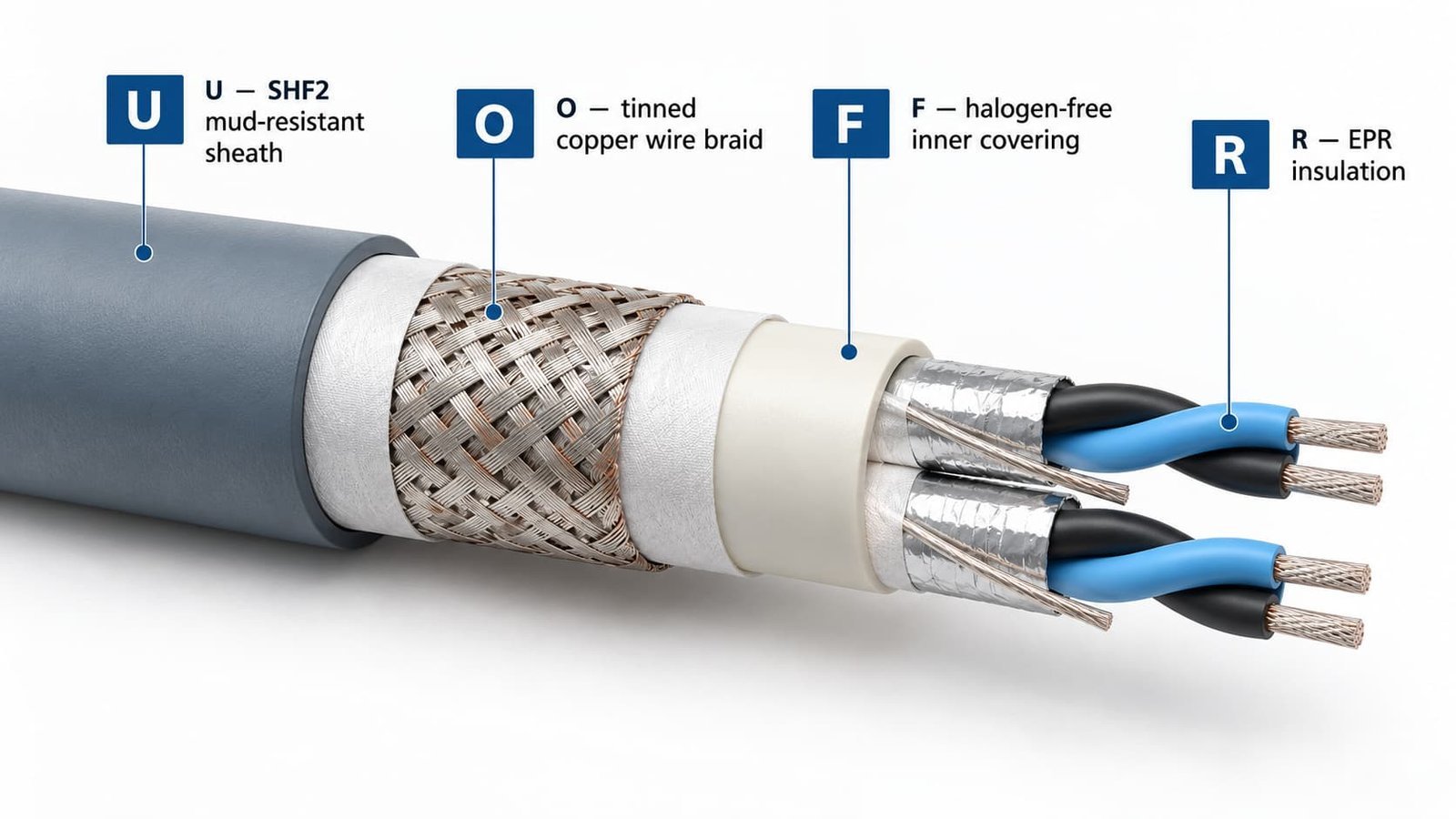
Tinned copper also appears outside the conductor. Shielded data and control cables may use a tinned copper braid and, under a foil shield, a tinned copper drain wire. Some combine a tinned braid with bare copper conductors. For when a shield is worth adding, see when a shield is needed. For the shield types themselves, see spiral vs braided shields.
Before ordering, ask our engineers to confirm whether the cable you are quoting can be supplied with tinned conductors.
Sources: damp and corrosive sites, Service Wire, Bare Copper, Southwire, “Tinned Conductors” and Consulting-Specifying Engineer (2005), which also covers CSPE and anti-corrosion compound; modern insulation, Okonite (2021); tin-coated ferrules, Phoenix Contact, “The ultimate question: Are ferrules necessary?”; shielded cable constructions, Belden 9841 datasheet (2026) and Lapp Unitronic LiYCY catalog page.
Is oxygen-free copper wire better than standard ETP copper?
For most cable conductors, no. In the annealed condition, ETP copper (UNS C11000) and oxygen-free copper (C10200) share the same minimum conductivity of 100 % IACS. The electronic grade, OFE (C10100), has a minimum of 101 % IACS. Oxygen-free grades matter mainly where copper is brazed or welded and must not suffer hydrogen embrittlement, and in vacuum seals.
Three copper grades
| Grade | UNS | EN | Minimum copper¹ | Oxygen | Where it matters |
|---|---|---|---|---|---|
| Electrolytic tough pitch (ETP) | C11000 | Cu-ETP (CW004A) | 99.90 % | Present; the level varies with the process | The normal conductor grade; excellent for soldering, good for brazing, not recommended for oxyacetylene welding |
| Oxygen-free (OF) | C10200 | Cu-OF (CW008A) | 99.95 % | 0.0010 % max. | Brazing and welding without hydrogen embrittlement |
| Oxygen-free electronic (OFE) | C10100 | Cu-OFE (CW009A) | 99.99 % | 0.0005 % max. | Vacuum seals; brazing and welding without hydrogen embrittlement |
¹ Includes silver for ETP and OF; excludes silver for OFE.
The difference lies in the oxygen. ETP copper contains a small amount of oxygen. Oxygen-free grades are made without deoxidizers, and the Copper Development Association lists them as not hydrogen-embrittling during brazing or welding. It rates ETP as not recommended for oxyacetylene welding.
ETP is still the normal conductor grade. The Copper Development Association lists it against the ASTM wire and stranding standards, from B1 to B355.
“OFC” on a label does not name a specific grade or standard. Ask for the UNS or EN number, or the standard, instead. For ordinary power, control, data and EV cables, specify annealed copper to the cable standard. Ask for OF or OFE by number only when one of the duties above applies.
Sources: composition, oxygen, conductivity, brazing and welding, Copper Development Association data pages for C11000, C10200 and C10100; EN designations and oxygen in ETP, Kemper, Cu-ETP and Cu-OF, and Aurubis, C10100 (Cu-OFE) datasheet; oxygen-free copper made without deoxidizers, ASTM B170-24 (title and scope).
Is stranded or solid copper wire better?
Neither is better in general. Solid copper suits fixed wiring; stranded copper suits cables that bend during installation, and fine-stranded copper suits cables that flex in service.
IEC 60228 groups conductors as Class 1 (solid), Class 2 (stranded), Class 5 (flexible) and Class 6 (more flexible than Class 5). For the wider picture, see how electrical cables are classified.
In US standards, concentric-lay stranding follows ASTM B8, and bunch-stranded and rope-lay conductors follow ASTM B174, B172 and B173. All four cover uncoated and tin-coated wires, so stranding and coating are separate choices.
Three points decide the construction:
- Movement. Flexibility rises with the number of wires in a given cross-section. Repeated flexing therefore calls for fine-stranded (flexible) copper, because solid and stranded conductors are intended for cables in fixed installations. See moving machines and harsh environments.
- Installation. Fixed cables still have to be bent into place, and stranded copper makes that easier. For US building wire, see whether THHN is solid or stranded.
- Termination. Terminals to EN 60999-1 must accept unprepared solid, stranded and flexible conductors. Under IEC 60947-7-1, the terminal maker states any pre-treatment, such as a ferrule, so follow that instruction for fine-stranded ends, bare or tinned.
Sources: conductor classes and their intended use, IEC 60228:2023, with class wording from IEC 60228:2004, clause 3 (preview); ASTM B8, B172, B173 and B174 (scopes); flexibility, JOKARI, “Conductor classes for cables and wires” (2024); terminal standards EN 60999-1 and IEC 60947-7-1, as summarized in Phoenix Contact, “The ultimate question: Are ferrules necessary?”.
Why is copper used for conductors, and how do you spot copper-clad aluminum?
Copper is the default conductor metal because it conducts well and is easy to solder, braze and terminate. Copper-clad aluminum (CCA) and copper-clad steel (CCS) look like copper but have an aluminum or steel core, so their resistance differs from all-copper wire of the same size. Check the datasheet, a scraped end, the weight and, for data cable, a resistance test before accepting a reel.
Annealed copper is the reference for conductivity. The International Annealed Copper Standard, adopted by the IEC as IEC 60028, defines 100 % IACS. Aluminum conducts less, so an aluminum conductor needs a larger cross-section for the same resistance. For alloys, compact stranding and connections, see our aluminum conductor guide.
Both clad wires have legitimate uses. CCS has a copper cladding metallurgically bonded to a steel core. It serves in grounding grids and as the center conductor of some coaxial cables, including CATV drop wire. CCA also serves as a center conductor in some specialty coaxial cables. Neither is copper, and a cable sold as copper should not contain them. In 2011, the Communications Cable and Connectivity Association (CCCA) and the Copper Development Association warned that Category cable with CCA conductors did not comply with the NEC or UL 444.
Use four checks before accepting a reel:
- Datasheet and legend. The datasheet and the print legend name the conductor material. Confirm any listing mark in the certifier’s online directory, because a printed mark alone is not proof.
- Scraped end. A cut end of copper wire shows copper all the way through, while CCA and CCS show their aluminum or steel core inside a thin copper layer. On CCA, scraping the thin copper surface exposes bright aluminum underneath.
- Weight. The reel weight fits copper. Aluminum is lighter, although a box can be ballasted to hide the difference.
- Resistance test. For data cable, a cable certifier’s DC resistance unbalance test can flag CCA conductors.
Before ordering, ask our engineers to confirm the conductor material.
Sources: IEC 60028:1925, International standard of resistance for copper (title and scope); IACS as adopted by the IEC, NBS Handbook 100, Copper Wire Tables (1966); soldering and brazing, Copper Development Association, C11000; ASTM B566-04a(2025), B452-22(2026) and B869-07(2023) (titles and scopes); CCS and CCA uses, Copperweld grounding conductors and signal wire; code compliance and identification, CCCA and CDA notice of March 4, 2011; identification and the higher resistance of aluminum, Fluke Networks, tips to identify CCA cables (2017).
Where do our cables use tinned copper conductors?
TEBAOFLEX can make a 120 Ω RS-485 data bus cable with tinned copper conductors, PE insulation and a foil plus braid shield. For our other cables, confirm the conductor coating with each order.
| Cable | Conductors | Insulation | Shield |
|---|---|---|---|
| 120 Ω RS-485 data bus cable (made to order) | Tinned copper | PE (polyethylene) | Foil plus braid |
Before ordering, ask our engineers to confirm the pair count, conductor size and stranding of the RS-485 cable for your bus. For cables in our PVC control and data cable and EV charging cable ranges, ask them to confirm the conductor material, coating (plain or tinned) and construction.
What should you send us for a quotation?
Send these details with your inquiry through our contact page:
- Function and rated voltage
- Number of cores × cross-section, in mm² or AWG
- Conductor coating: plain or tinned
- Conductor construction: solid, stranded or fine-stranded
- Copper grade by UNS or EN number, if the duty needs OF or OFE copper (our engineers will confirm whether it can be supplied)
- Shield or drain wire, if any
- Environment: dry, damp or corrosive, and any soldered ends
- Standard and target market
- Length and quantity
Our minimum order quantity is 50 m for standard and custom cables alike. Lead time is 7–45 working days, depending on product type, stock and customization, and the written quotation confirms it.
Frequently asked questions
Is tinned copper wire better than bare copper wire?
Only where the coating pays off: a continuously damp or corrosive site, soldered ends, sulfur-bearing insulation or a standard that requires tinned conductors. In dry, fixed installations with crimped or clamped terminations, bare copper does the same job at lower cost. Use the three questions to decide.
Can tinned copper wire be used for grounding?
Yes. Some makers offer solid and stranded copper for grounding systems in bare or tinned versions, and tinned soft copper wire is made to ASTM B33. Choose tinned where the site is continuously damp or corrosive. Size and installation follow the electrical code that applies to the site. See bare copper wire for the tempers.
What are the disadvantages of tinned copper wire?
The main disadvantages are cost and supply. Tinning adds a process step, so tinned conductors cost more and can take longer to supply. For most dry, fixed installations with modern insulation, the coating is no longer needed. The comparison table lists the other differences.
Should you solder-tin stranded wire ends before clamping them in a terminal?
Not in screw terminals. Solder fills the gaps between the strands, and under clamping pressure and heat it can flow or crack, so the connection loosens. Use a ferrule or a terminal made for fine-stranded conductors instead. This concerns solder-dipped ends, not conductors made from tinned wires.
Is bare copper wire solid or stranded, soft or hard?
Bare copper wire comes in all of these forms: it is sold solid or stranded, in soft (annealed), medium-hard and hard-drawn tempers. Soft wire to ASTM B3 is the flexible temper and is used for grounding conductors. Hard-drawn wire to ASTM B1 is stiffer and is offered for bare overhead and grounding conductors. See bare copper wire.
How can you tell if wire is tinned copper or aluminum?
Cut the wire and look at the end. Tinned copper shows copper-colored metal under its thin tin coating, while copper-clad aluminum shows bright aluminum under a thin copper surface. Aluminum is also lighter than copper. Check that the datasheet names the conductor material. The four checks cover copper-clad wire in more detail.
Sources: grounding, Service Wire, Solid Bare Copper, Stranded Bare Copper and Bare Copper, with ASTM B33, B3 and B1 (scopes); cost, lead time and need, Okonite (2021) and Southwire, “Tinned Conductors”; soldered ends, Phoenix Contact, “The problems with tinning wires” (2018) and “Are ferrules necessary?”; identification, CCCA and CDA notice (2011) and Fluke Networks (2017).
What should you do next?
Start with size, then make the four choices: grade, temper, surface and construction. Choose tinned copper for continuously damp or corrosive sites, soldered ends or a standard that requires it, and bare copper for dry, fixed work. Treat ETP copper as the normal grade, and name OF or OFE only for brazing, welding or vacuum duties. Use fine-stranded copper for cables that flex in service, and check that copper is really copper. When you are ready, send the conductor coating, construction, size, standard and environment to our engineers through the contact page.