Aluminum vs Copper Wire: How to Choose an Aluminum Conductor
Aluminum vs copper wire explained: conductivity, weight, AA-8000 and 1350 alloys, compact stranding, connections and when aluminum makes sense.

In aluminum vs copper wire, copper conducts better for its size and tolerates bending; aluminum is lighter for the same resistance, so it suits large, fixed runs. An aluminum conductor is the aluminum or aluminum-alloy wire, or bundle of wires, that carries current inside a cable or overhead line. The conductor is the first layer in the parts of an electrical cable; for copper conductors, see our copper conductor guide.
Aluminum wire sold for crafts, floral work or fencing is outside this guide. This guide covers aluminum as the conductor of electrical cables and overhead lines.
Aluminum and copper at a glance
| Question | Short answer | Section |
|---|---|---|
| Which conducts better for its size? | Copper | Aluminum vs copper wire |
| Which aluminum alloy is in modern US building wire? | 8000 series (ASTM B800) | AA-8000 vs 1350 |
| Can aluminum be used where a cable flexes? | Not as an IEC 60228 flexible conductor | Bending and movement |
| Where do most aluminum failures start? | At connections | Aluminum connections |
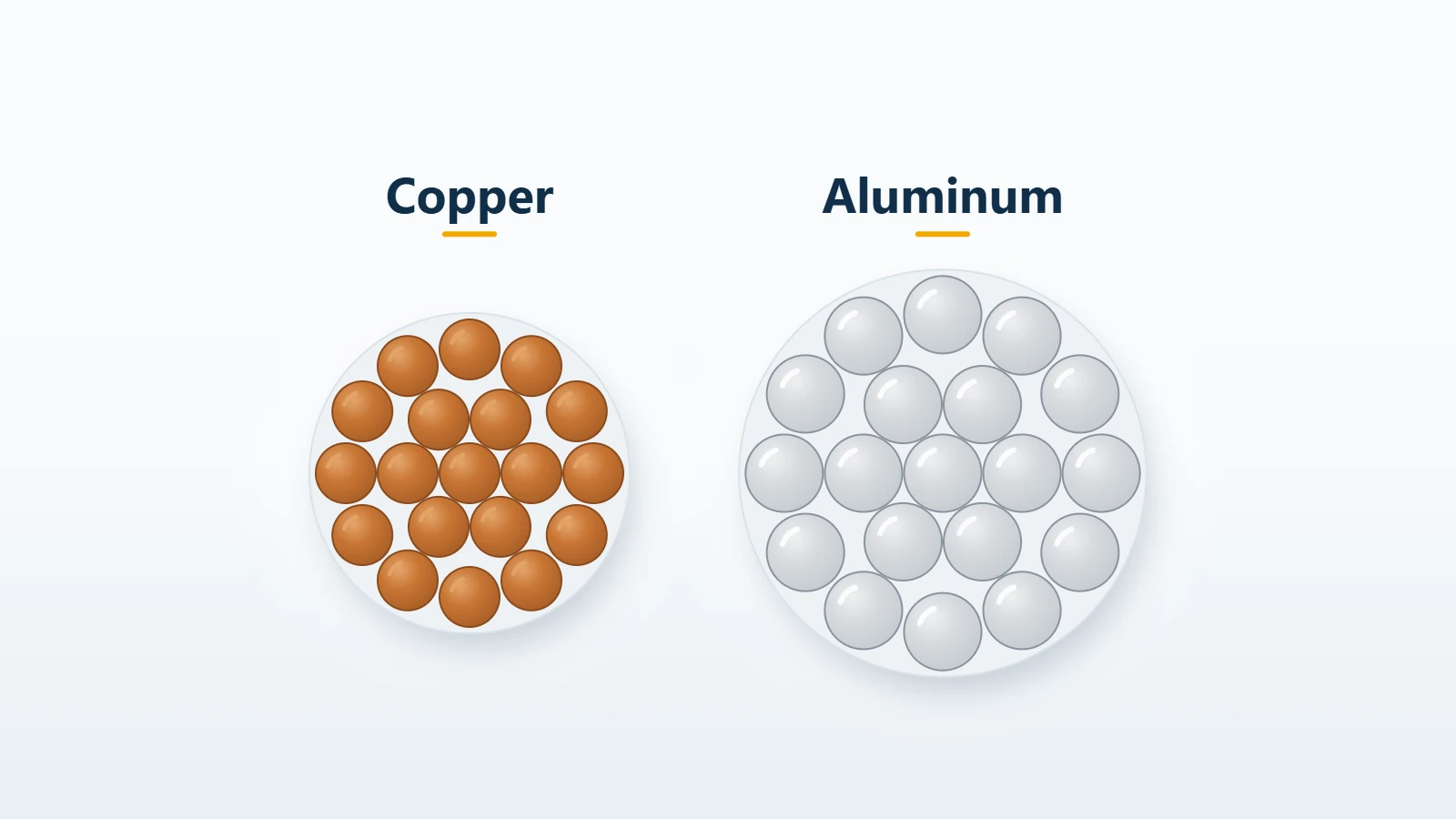
Sources: IEC 60228:2023, scope and table titles (preview); ASTM B800-05(2021) (title and scope); CPSC Publication 516, Repairing Aluminum Wiring (June 2011); hero scale, calculated from the 61.0 % IACS value for hard-drawn 1350 aluminum in NBS Handbook 109, Aluminum Wire Tables (1972).
What is an aluminum conductor, and where is it used?
An aluminum conductor is a solid or stranded wire of electrical-grade aluminum or aluminum alloy, used mainly in overhead lines, utility distribution, and large feeder and service conductors.
Two alloy families cover most aluminum conductors. One is 1350 aluminum, formerly called EC aluminum. The other is the 8000 series, the alloys used in US building wire; the AA-8000 section compares the two.
Overhead lines use bare stranded aluminum and aluminum-alloy conductors. IEC 62641 covers the “aluminium and aluminium alloy wires” stranded into them, and ASTM B231 covers concentric-lay-stranded 1350 conductors. For where overhead conductors sit among other cable types, see power cables.
For insulated cables, IEC 60228 covers copper, aluminum and aluminum-alloy conductors in cables for fixed installations, plus flexible copper conductors. Aluminum appears there only as solid (Class 1) or stranded (Class 2) conductors.
In North America, aluminum appears in building wire and cable types such as XHHW-2, THHN/THWN-2 and MC cable; our THHN wire guide explains those types.
Copper-clad aluminum (CCA) is a separate product, with an aluminum core under a thin copper layer. It is covered in copper vs copper-clad aluminum.
Sources: 1350 wire and its former EC name, ASTM B609/B609M-12(2021) and B230/B230M-22; stranded 1350, B231/B231M-23; 8000 series, B800-05(2021) and B801-18(2023) (all titles and scopes); overhead wires, IEC 62641:2022 (title); IEC 60228:2023, clause 1 scope and clauses 5.2 and 5.3 (preview); classes by material, Nexans, “Construction of cable cores according to IEC 60228”; transmission and distribution, The Aluminum Association, Electrical; building-wire types, Prysmian, XHHW-2 aluminum building wire, SPEC 5180A (2017) and Southwire, SPEC 60386 (2024).
Aluminum vs copper wire: what is the difference?
Copper conducts better for its size, is stronger and resists fatigue; aluminum is lighter for the same resistance but needs a larger cross-section and more careful connections. Whichever way the question is asked, copper vs aluminum wire comes down to conductivity, density, strength and surface chemistry.
Annealed copper is the reference for conductivity. IEC 60028 defines the International Annealed Copper Standard, so annealed copper is 100 % IACS. Hard-drawn 1350 aluminum is 61.0 % IACS and annealed 1350 is 61.8 %, so, size for size, 1350 aluminum conducts about 61 % as well as annealed copper.
Aluminum has a density of 2.703 g/cm³, against 8.89 g/cm³ for copper. From these values, an aluminum conductor of the same resistance has about 1.64 times the cross-section and 1.28 times the diameter of copper. It still has only about half the mass.
That explains a common conflict between comparison pages. Some say aluminum conducts more, others say less. Per kilogram, aluminum conducts more; per square millimeter, it conducts less, which is why it suits long, heavy overhead and feeder runs.
Aluminum vs copper wire
| Property | Aluminum | Copper |
|---|---|---|
| Conductivity | About 61 % IACS for 1350 aluminum (61.0 % hard-drawn, 61.8 % annealed) | 100 % IACS, the reference for annealed copper |
| Cross-section for the same resistance | About 1.64 times that of copper (calculated) | Smaller |
| Mass for the same resistance | About half that of copper (calculated) | About twice that of aluminum |
| Strength and fatigue | Lower; more prone to break under repeated bending or vibration | Stronger, with better fatigue resistance |
| Thermal expansion and creep | Expands more with heat; older 1350 building wire has a higher creep rate than copper, while 8000-series alloys have creep rates very similar to copper | Expands less with heat |
| Surface oxide | Forms a non-conductive oxide layer that can raise connection resistance if not managed | Less critical at connections |
| IEC 60228 conductor classes | Class 1 and Class 2 only | Classes 1, 2, 5 and 6 |
| Terminals and connectors | Must be identified for aluminum; joints to copper need a connector rated for both | Standard copper terminals |
| Material cost | Lower per pound, and upfront material cost can be lower even with the larger conductor; compare quotations | Higher per pound |
| Typical use | Overhead lines, utility distribution, large fixed feeders and service conductors | Most building, control, data, EV and flexing cables |
Ampacity for a given installation comes from the applicable code tables, such as NEC Table 310.16 in the US, which list aluminum separately from copper.
Sources: conductivity and density, NBS Handbook 109, Aluminum Wire Tables (1972), Table 1, and NBS Handbook 100, Copper Wire Tables (1966); IEC 60028:1925, International standard of resistance for copper (title and scope); cross-section, diameter and mass ratios calculated from those conductivity and density values; strength, fatigue, expansion, oxide and material cost, Service Wire, “Copper vs. Aluminum: Should I Specify Copper or Aluminum Wire?”; creep, IAEI Magazine, C. Hunter, “Aluminum Building Wire Installation and Terminations” (2006); classes, IEC 60228:2023 (preview) and Nexans; terminal identification, NEC 110.14(A) (NFPA 70-2023 and NFPA 70-2026), reprinted in EC&M, “Practically Speaking: AL-CU Versus CO/ALR Markings” (2026); NEC Table 310.16 title and its separate aluminum columns, NFPA 70 A2025 CMP-6 First Draft (NFPA 70-2023 base text) and Mike Holt, Understanding the 2026 National Electrical Code, Vol. 1 (2026) (NFPA 70-2026).
What is AA-8000 aluminum wire, and how does it differ from 1350?
AA-8000 aluminum wire is building wire with an 8000-series alloy conductor (wire to ASTM B800); unlike older 1350 (EC) building wire, it creeps at rates very similar to copper. These alloys were developed in the late 1960s, and listed wire has been made since 1972.
The change followed trouble with 1350 aluminum in branch circuits. A copper shortage in the mid-1960s had pushed aluminum from a few large circuits into general 15 A and 20 A circuits. Wire made before 1972 was 1350 (EC) aluminum, which has a higher creep rate than copper building wire. Creep is a slow change in a metal’s dimensions under a steady force. With workmanship and differences in thermal expansion, it was among the causes most often identified for reported failures at steel terminal screws.
Two aluminum conductor alloy families
| Alloy | Wire standard | Stranded conductor standard | Typical use |
|---|---|---|---|
| 1350 (formerly EC) | ASTM B609 (annealed and intermediate tempers); ASTM B230 (H19, extra-hard) | ASTM B231 (concentric-lay-stranded) | Overhead and utility conductors; older US branch-circuit wire made before 1972 |
| 8000 series, for example 8030 or 8176 | ASTM B800 (annealed and intermediate tempers) | ASTM B801 (compact-round, compressed and conventional concentric-lay, for covering or insulation) | US building wire and cable, such as XHHW-2 |
The NEC (NFPA 70) requires 8000-series alloy for solid 8, 10 and 12 AWG aluminum conductors. It also requires it for the stranded aluminum building-wire types it lists, from 8 AWG through 1000 kcmil.
The rule is older than its current section number. The NEC has required aluminum alloy conductors for 12–8 AWG branch-circuit wiring since 1981, and it first specifically required AA-8000 series conductors in 1987.
Sources: ASTM B609/B609M-12(2021), B230/B230M-22, B231/B231M-23, B800-05(2021) and B801-18(2023) (titles and scopes); alloy numbers, Prysmian, SPEC 5180A (2017) (8030) and Prysmian Centroamérica, XHHW-2 AA8000 datasheet (8176); history, pre-1972 wire, creep, causes of failure and NEC dates, IAEI Magazine (2006); copper shortage, CPSC Publication 516 (2011); NEC requirement, NEC 310.3(B) (NFPA 70-2023) and 310.5(B) (NFPA 70-2026), summarized in EC&M, “Stumped by the Code?” (2023) and Mike Holt, Understanding the 2026 National Electrical Code, Vol. 1 (2026), with the stranded scope in the NFPA 70 A2025 CMP-6 First Draft and Second Draft.
What is a compact aluminum conductor?
A compact aluminum conductor is a stranded conductor whose wires are shaped during stranding, which closes most of the gaps between round wires and makes the conductor smaller. US aluminum building wire is commonly supplied as compact stranded 8000-series alloy.
ASTM B801 names three constructions for 8000-series conductors that will be covered or insulated:
- Conventional concentric. Round wires lie in concentric layers, with gaps between them.
- Compressed. The stranded wires pass through a die that slightly flattens them, so the gaps shrink.
- Compact. The wires are shaped so the gaps are nearly closed and the conductor is the smallest of the three.
IEC 60228 uses different words for the same idea. It places stranded compacted circular conductors, stranded shaped conductors and Milliken conductors in Class 2. Its clause C.3 sets dimensional limits for compacted copper, aluminum and aluminum-alloy conductors. For the wider picture, see how cables are classified.
A smaller conductor gives a smaller insulated core, which matters for a buyer. For US building wire, the NEC has separate dimension and raceway-fill tables for compact conductors, so use the table that matches the stranding.
Connector standards treat the stranding types separately: UL 486A-486B covers stranded aluminum conductors in concentric, compressed and compact forms. Check that the connector is rated for the conductor’s stranding before you order both.
Solid versus stranded selection for copper is covered in stranded vs solid copper.
Sources: three constructions, ASTM B801-18(2023) (title and scope); compressed and compact fill compared, US Patent 5,496,969, “Concentric compressed unilay stranded conductors” (1996); smaller compact conductor, IAEI Magazine (2006); compact 8000-series building wire, Southwire, SPEC 60386 (2024), Prysmian, SPEC 5180A (2017) and Prysmian Colombia, XHHW-2 CT aluminum cables (2022); IEC classes and compacted conductors, IEC 60228:2023, clauses 6.3, 6.4 and C.3 (preview); compact-conductor tables, EC&M, C. Hunter, “Installing Aluminum Building Wire” (2007) and EC&M, “Chapter 9 of the NEC — Part 4” (2021); connector stranding types, UL 486A-486B, Wire Connectors (scope).
Can aluminum conductors be used where a cable bends or moves?
Generally no. IEC 60228 defines aluminum conductors only as solid (Class 1) or stranded (Class 2); its flexible classes, 5 and 6, are copper only.
Conductor classes by material
| IEC 60228 class | Description | Copper and tinned copper | Aluminum and aluminum alloy |
|---|---|---|---|
| Class 1 | Solid | Yes | Yes |
| Class 2 | Stranded | Yes | Yes |
| Class 5 | Flexible | Yes | Not defined |
| Class 6 | More flexible than Class 5 | Yes | Not defined |
The material explains the rule. Copper has better fatigue resistance, which matters when a conductor bends again and again or vibrates. Copper also performs better in vibration-prone installations.
Stranding alone does not make an aluminum conductor flexible: in IEC 60228, Class 2 is a stranded class for fixed installations, not a flexible one. Cables that move in service, such as those on moving machines and portable equipment, therefore use flexible copper conductors. See moving machines and harsh environments.
Sources: IEC 60228:2023, clause 7 and Tables 5 and 6, “flexible copper conductors” (preview); classes by material, Nexans; fatigue and vibration, Service Wire.
Why do aluminum connections need more care than copper?
Because aluminum forms a non-conductive oxide layer and expands more with heat, a connection not made for aluminum can loosen, heat up and fail. Older 1350 building wire also has a higher creep rate than copper, while 8000-series alloys creep at rates very similar to copper.
The U.S. Consumer Product Safety Commission (CPSC) describes the failure path. Deterioration at aluminum connections raises their resistance. The extra resistance causes overheating while current flows, and the damage is cumulative.
Identified parts are the first defense. The NEC requires terminals used to connect aluminum to be identified for it. Under UL 486A-486B, a connector for aluminum, copper-clad aluminum and copper conductors is marked “AL-CU” or “CU-AL”. The 2023 NEC limits 15 A and 20 A receptacles not marked CO/ALR to copper and copper-clad aluminum conductors. The 2026 edition bars any wiring device not marked CO/ALR from directly terminating aluminum conductors.
Join aluminum to copper only with a connector rated for aluminum and copper. Surface preparation and tightening follow the connector maker’s instructions and the applicable code. Terminating AA-8000 and copper wire involves the same steps.
Power-cable connectors have their own IEC test standard. IEC 61238-1-1 sets test methods and requirements for compression and mechanical connectors on copper and aluminum conductors in power cables up to 1 kV.
Sources: failure mechanism, CPSC Publication 516 (2011); oxide and expansion, Service Wire; creep, IAEI Magazine (2006); NEC 110.14(A) (NFPA 70-2023 and NFPA 70-2026) and CO/ALR devices, NEC 406.3(D)(1) (NFPA 70-2023) and 406.10(2)(a) (NFPA 70-2026), reprinted in EC&M (2026); connector scope and marking, UL 486A-486B, Wire Connectors, and the Intertek Standards Update Notice (2024) for UL 486A-486B; termination steps, EC&M (2007); IEC 61238-1-1:2018 (title and abstract).
Is aluminum wiring safe in homes?
Older aluminum wiring in homes is a fire concern at its connections, and the U.S. Consumer Product Safety Commission (CPSC) recommends hiring a qualified electrician rather than doing it yourself. The concern is branch-circuit wiring from about 1965 to the mid-1970s.
CPSC traces the issue to a copper shortage in the mid-1960s, which brought aluminum into general 15 A and 20 A circuits. Homes built before 1965 are unlikely to have aluminum branch-circuit wiring.
Its key finding, from a national survey, has a narrow scope. Aluminum-wired homes built before 1972 are 55 times more likely to have one or more wire connections at outlets reach “Fire Hazard Conditions” than homes wired with copper. That survey covered only wire connections at outlets, and no information was developed for aluminum-wired homes built after 1972.
Cable with aluminum conductors is marked “Al” or “Aluminum” on its outer covering. CPSC’s repair guidance does not apply to larger aluminum circuits for service entrance cables, clothes dryers and cooking ranges. Modern 8000-series building wire is a different product.
For an existing home, have a qualified electrician evaluate the wiring; CPSC Publication 516 lists the repair methods it accepts.
Sources: dates, circuits, the outlet survey and its scope, markings and the limits of the repair guidance, CPSC Publication 516, Repairing Aluminum Wiring (June 2011).
When should you specify aluminum instead of copper?
Specify aluminum for large, fixed conductors where weight or material price matters and the code and equipment accept it. Specify copper for small circuits, anything that flexes or vibrates, and copper-only terminals.
Aluminum or copper? Ask three questions:
- Will the cable flex, vibrate or move in service?
- Are any terminals or connectors rated for copper only?
- Is it a large, fixed run where weight or material price matters?
A yes to question 1 or 2 means copper. A no to both and a yes to question 3 means aluminum may suit; a no to question 3 means copper.
For example, a long service feeder with lugs identified for aluminum gets no to questions 1 and 2 and yes to question 3, so aluminum may suit it. A control cable to a machine axis gets a yes to question 1, so it stays copper.
Aluminum is common in overhead lines, utility distribution, service entrance conductors and large feeders. Copper remains the normal choice for control, data, EV charging and instrumentation cables, small branch circuits and moving equipment. For the copper choices, see four choices that define a copper conductor and ETP vs oxygen-free copper.
Space matters as well. Aluminum’s larger conductor needs larger lugs, connectors and termination space, so check the equipment data before you change material.
Before ordering, ask our engineers to confirm the conductor material of the cable you are quoting, and state in your inquiry whether aluminum is acceptable.
Sources: classes and flexing, IEC 60228:2023 (preview); termination space, vibration and material cost, Service Wire; transmission and distribution, The Aluminum Association; service entrance and feeder use, EC&M (2007) and CPSC Publication 516 (2011), footnote 3.
Frequently asked questions
Which is better, copper or aluminum wire?
Neither is better for every job. Copper conducts better for its size, is stronger and suits small circuits and anything that flexes. Aluminum is lighter for the same resistance and can cost less upfront, so it suits large, fixed runs with terminals identified for aluminum. The comparison table lists ten differences.
What are the disadvantages of aluminum wire?
Aluminum needs a larger cross-section than copper for the same resistance, so it takes more room at lugs and terminals. It has lower fatigue resistance, forms a non-conductive oxide layer and expands more with heat. IEC 60228 also defines no flexible aluminum conductor. Most of these points matter at connections.
Why would you use aluminum wire instead of copper?
For weight and material price on large runs. For the same resistance, aluminum has about half the mass of copper, which matters on overhead spans and long feeders. The Aluminum Association calls it the preferred material for transmission and distribution. See power cables and when to specify aluminum.
Is aluminum wiring still allowed in new buildings?
Yes. The NEC still covers aluminum conductors, and it requires 8000-series alloy for solid 8, 10 and 12 AWG conductors and for the stranded building-wire types it lists. Equipment terminals must also be identified for aluminum, and local rules may add limits. See AA-8000 vs 1350 aluminum.
Can aluminum wire be connected to copper wire?
Yes, but only with a connector rated for aluminum and copper, such as one marked AL-CU or CU-AL. Install it to the connector maker’s instructions and the applicable code. A connector rated for copper only is not suitable for the joint. See aluminum connections for why the joint needs this care.
How can you tell if wire is aluminum or copper?
Check the marking first: cable with aluminum conductors is marked “Al” or “Aluminum” on its outer covering, and “CU-clad” or “Copper-clad” beside it means copper-clad aluminum. At a cut end, aluminum is silver-gray all the way through, while copper-clad aluminum shows a thin copper layer over aluminum. See the four checks for copper-clad wire.
Sources: comparison points and upfront material cost, Service Wire, IEC 60228:2023 (preview) and Nexans; mass, calculated from NBS Handbook 109 and NBS Handbook 100; transmission and distribution, The Aluminum Association; NEC requirement, NEC 310.3(B) (NFPA 70-2023) and 310.5(B) (NFPA 70-2026), summarized in Mike Holt (2026); connector marking, the Intertek Standards Update Notice (2024) for UL 486A-486B; cable and copper-clad markings, CPSC Publication 516 (2011); silver-colored aluminum under copper cladding, Fluke Networks (2017).
What should you do next?
Choose copper for conductivity per size, strength and anything that flexes, and aluminum for weight and material price on large, fixed runs. For US building wire, aluminum means 8000-series alloy, commonly compact stranded. Most aluminum failures start at connections, so check that every terminal and connector is identified for aluminum. When you are ready, send the conductor material, whether aluminum is acceptable, and the size, construction, standard and environment to our engineers through the contact page.